
What Is MES System?
What is MES? A manufacturing execution system (MES) is software used to manage, monitor and record production on the shop floor. It connects production orders and production schedules with information about raw materials, operations and quality, using data from machines, operators and other systems to give manufacturers real-time visibility into shop floor operations, improve efficiency and help ensure products meet quality standards.
MES systems monitor and control manufacturing operations in real time, providing real-time visibility into manufacturing operations and detailed tracking of manufacturing processes.
MES systems monitor and control manufacturing operations in real time, providing real-time visibility into manufacturing operations and detailed tracking of manufacturing processes.
MES helps teams answer practical questions: How far has an order progressed? What is delaying it? Which material lots were used? For manufacturing companies running complex shop floors, multiple plants, or a mix of legacy and modern equipment, that visibility is critical for reducing downtime, improving quality, supporting compliance and making better day-to-day production decisions.
This article explains what MES does, how it differs from ERP, OEE and SCADA, where it improves and where it falls short, what affects implementation and cost, how to compare MES software, and why it plays a central role in operational excellence and digital transformation.
MES System Overview
Co oznacza skrót MES?
Skrót MES oznacza Manufacturing Execution System (system realizacji produkcji). Termin ten odnosi się do oprogramowania, które wspiera realizację i rejestrowanie operacji produkcyjnych. W odniesieniu do tej kategorii można również spotkać się z terminami „oprogramowanie MES”, „system MES” oraz „oprogramowanie do realizacji produkcji”.
Jakie są zadania systemu realizacji produkcji?
Production information is often spread across paper records, spreadsheets and machine readings. MES brings those records into the context of the manufacturing process: an output count belongs to an order, a raw-material lot belongs to a batch, and a quality-control result belongs to an operation.
Supervisors use this information to follow progress. Operators access instructions and record work. Quality teams review process history when investigating a problem. When the necessary connections are available, MES can give teams near-real-time visibility into production status. It does not make incomplete or inaccurate data reliable automatically; data definitions, collection rules and ownership still matter.

Jak działa system MES? Przykład zlecenia produkcyjnego
Consider a parts manufacturer running an order through several operations and an inspection. This simplified example shows how mes works by collecting data about production activities across the workflow, rather than a specific customer deployment.
Depending on the architecture, MES may exchange data with ERP, PLC or SCADA, quality, warehouse and other business systems. The useful question is which information must move between systems, how often it should be updated, and who owns the data when a connection is unavailable. Supervisors can follow production progress on the factory floor and use that information to make informed decisions, while connected data can also reveal machine performance and support product quality.
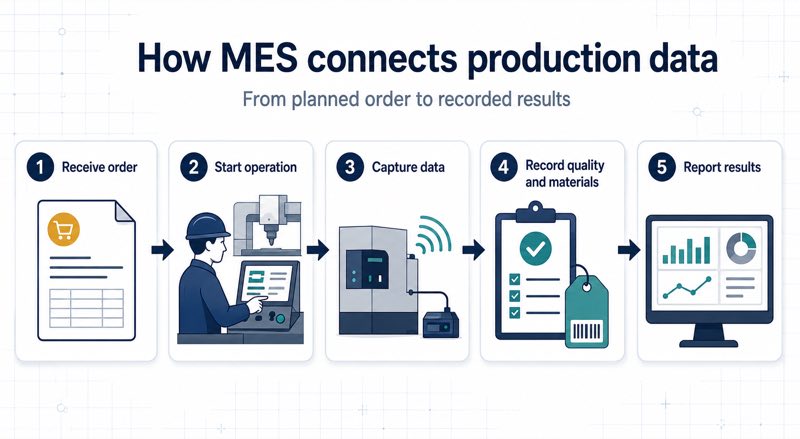
Otrzymanie zlecenia produkcyjnego
The order enters MES, for example through an ERP integration. Under ISA-95, MES sits at Level 3 between enterprise systems and control systems. It includes the product, planned quantity and information needed to carry out the operations, while linking with other enterprise systems to support production planning.
Rozpocznij operację
The operator selects the task and records its start. Depending on configuration, MES provides the relevant work instructions and checks the materials assigned to the workstation, which is especially useful in regulated industries. When the order enters MES through ERP integration, it also supports production planning between enterprise systems and lower-level control systems with visibility across the entire production process.
Capture real time data and execution data
Machine readings provide operating status and output counts, which helps flag potential issues early. In regulated industries, these checks help maintain visibility across the entire production process at the workstation level. The operator adds information the machine cannot identify, such as the reason for a stoppage, supporting production efficiency.
Jakość zapisu i historia materiału
Inspection results are linked to the relevant operation or batch, and machine readings can also highlight potential issues that affect production efficiency as part of quality management. Material records connect incoming lots to the finished product, supporting later investigation.
Zrealizować zadanie i przedstawić wyniki
The team reviews completed work. Agreed results, such as output quantities, material consumption, and inspection results as part of quality management linked to the relevant operation or batch, can return to ERP and other enterprise systems for planning and reconciliation, giving teams a comprehensive view.
What are the main MES functions, including production scheduling?
Typical MES functions include managing production operations across factory floor operations and sharing execution data upward:
- Production scheduling, order execution and work-in-progress tracking
- Production and machine data collection, including near-real-time status where connected
- Identyfikowalność materiałów i historia produktu
- Cyfrowe instrukcje pracy, quality control and in-process records
- Downtime analysis, production performance and reporting
The exact combination varies between products and implementations. Some systems connect to maintenance, inventory or resource-management modules, while others keep those processes in separate applications. When results return to ERP, sharing that data with other enterprise systems can provide a more comprehensive view for planning and reconciliation. Compare the operational coverage, data flow and ownership of each system rather than relying on the product label alone.
MES a ERP: na czym polega różnica?
System planowania zasobów przedsiębiorstwa (ERP) covers business processes such as purchasing, finance, inventory control, planning and human resources. MES functions support production operations and connect factory floor operations with execution records and reporting. Integration allows business plans and reporting to use actual results from the shop floor.
Granice tych obszarów mogą się pokrywać. Niektóre rozwiązania ERP oferują rozbudowane funkcje produkcyjne. Przed wdrożeniem systemu MES należy ustalić, które wymagania spełnia już obecny system, a w jakich obszarach brakuje danych operacyjnych lub wsparcia procesowego.
| Porównanie | ERP | System MES |
|---|---|---|
| Główny cel | Zasoby biznesowe i transakcje | Realizacja na hali produkcyjnej |
| Przykładowe rekordy | Zamówienia, zapotrzebowanie na materiały, koszty | Stan działania, zdarzenia, historia partii |
| Przykład zastosowania | Zaplanuj i rozlicz zamówienie | Zapisz, w jaki sposób zrealizowano zamówienie |
MES a OEE: system a wskaźnik wydajności
Wskaźnik ogólnej efektywności sprzętu (OEE) jest wskaźnikiem opartym na dostępności, wydajności i jakości. Oprogramowanie do monitorowania wskaźnika OEE mierzy te czynniki i pomaga zespołom w analizie przyczyn strat. System MES obejmuje realizację produkcji w szerszym zakresie, w tym takie funkcje, jak śledzenie zamówień i historia materiałów.
Jeśli w pierwszej kolejności konieczne jest zrozumienie przyczyn przestojów maszyn, monitorowanie wskaźnika OEE może stanowić przydatny punkt wyjścia. Jeśli konieczne jest również powiązanie operacji z materiałami i wynikami jakościowymi, należy ocenić odpowiednie możliwości systemu MES.
Manufacturing operations management (MOM) describes the broader management of manufacturing operations, including production, quality, maintenance and inventory operations. MES refers to software for production execution. Vendors use these terms in different ways, so compare process coverage and capabilities rather than relying on the product label alone.
Jakie są zalety oprogramowania MES?
MES can make production information available sooner and reduce repeated manual entry when data is captured at the source, helping businesses improve operational efficiency. A connected material and process history helps quality teams investigate issues, while execution data allows production teams to compare plans with actual results and support operational excellence for customers.
Measure outcomes against a baseline to track productivity and increased efficiency. Useful KPIs might include reporting time, the time needed to retrieve batch history, data completeness, order completion performance, OEE, first-pass yield, and scrap rate. Account for changes in product mix, production load, and metric definitions when comparing results to increase productivity.
Jakie są ograniczenia systemu MES?
Oprogramowanie samo w sobie nie naprawia sprzętu ani nie koryguje błędnych danych podstawowych. Raport dotyczący przestoju nadal wymaga, aby ktoś zbadał przyczynę i podjął odpowiednie działania. Brakujące zapisy dotyczące materiałów również ograniczają przydatność genealogii produktu.
W związku z tym wdrożenie wymaga jasnych zasad gromadzenia danych, dbania o ich dokładność oraz reagowania na odchylenia. Należy określić, kto korzysta z poszczególnych raportów i jakie decyzje one wspierają. Pulpit analityczny ma ograniczoną wartość, jeśli nikt nie jest odpowiedzialny za podjęcie kolejnych działań.
Czy system MES zastępuje systemy sterowania maszynami?
System MES zazwyczaj współpracuje z warstwą automatyki i wykorzystuje jej dane. Nie zastępuje on funkcji sterowania maszyną ani funkcji bezpieczeństwa realizowanych przez sterowniki i dedykowane systemy bezpieczeństwa. Zakres odpowiedzialności każdej z warstw powinien być jasno określony w projekcie systemu.
MES vs SCADA: what is the difference?
Supervisory control and data acquisition (SCADA) systems focus on monitoring and supervisory control of equipment and processes. MES focuses on production execution: orders, operations, materials, quality records and production results. In many plants, SCADA and MES work together, with clear boundaries for control, data collection and operational decisions.
SCADA does not automatically provide the order, batch or genealogy context that an MES may manage, while MES does not replace controller or safety functions. The right architecture depends on the process, data sources and required response time.
Jak producent powinien przygotować się do wdrożenia systemu MES?
Choose the operational problem and initial production area based on your industry requirements and define how you will measure progress.
Document normal operations and exceptions, including rework, material substitutions, and order changes, to match the scope of systemu MES to actual processes and planning needs.
Identify data sources across machines, operator interfaces, connected business systems, and SCADA so teams have a real-time view of equipment while MES tracks execution status.
Agree on IT responsibilities, user access, and how production should operate during connectivity interruptions.
Przed uruchomieniem systemu należy przetestować rzeczywiste scenariusze z udziałem operatorów oraz określić kryteria akceptacji.
Ile kosztuje oprogramowanie MES?
Koszt systemu MES zależy od zakresu oprogramowania, liczby stanowisk roboczych lub lokalizacji, prac integracyjnych oraz gotowości sprzętu. Budżet powinien obejmować oprogramowanie, sprzęt, wdrożenie, szkolenia oraz bieżące wsparcie techniczne. Należy porównać całkowity koszt w tym samym okresie i przy takim samym zakresie.
W przypadku wdrożeń międzynarodowych należy sprawdzić walutę, w której sporządzono ofertę, zasięg usług w danym regionie oraz wszelkie prace specyficzne dla danej lokalizacji. Wspólna platforma oprogramowania nie oznacza, że każdy zakład ma ten sam proces, tę samą infrastrukturę lub ten sam nakład pracy związany z wdrożeniem.
Jak długo trwa wdrożenie systemu MES?
Nie ma jednego harmonogramu, który miałby zastosowanie do każdego projektu MES. Projekt pilotażowy dotyczący danych maszynowych, pierwsze uruchomienie w środowisku produkcyjnym oraz wdrożenie w całym zakładzie to różne etapy realizacji projektu. Na harmonogram wpływają zakres projektu, integracje, gotowość danych oraz czas przeznaczony na testy i szkolenia.
Oceniając proponowany harmonogram, należy zapytać, co będzie gotowe do działania na końcu, kiedy rozpocznie się realizacja oraz jakie warunki wstępne musi zapewnić producent. W przypadku wielu lokalizacji należy odróżnić wdrożenie początkowe od późniejszych etapów wdrażania i lokalnych dostosowań.
Jak porównuje się rozwiązania MES?
Poproś dostawców o zaprezentowanie rzeczywistego scenariusza produkcyjnego, uwzględniającego sytuacje wyjątkowe, takie jak przeróbki lub nieprawidłowy materiał. Sprawdź, które funkcje są zawarte w pakiecie, które wymagają dodatkowych modułów oraz w jaki sposób zapewniona zostanie obsługa integracji i bieżących zmian.
Najczęściej zadawane pytania dotyczące MES
Czy system MES może działać bez systemu ERP?
Tak, o ile wymagane informacje są dostępne z innych źródeł lub zostały wprowadzone do systemu MES. Integracja z systemem ERP stanowi raczej metodę wymiany danych, a nie warunek konieczny do funkcjonowania systemu MES.
Czy wszystkie dane MES muszą pochodzić bezpośrednio z maszyn?
Nie. System MES może łączyć automatyczne odczyty z raportami sporządzanymi przez operatora. Należy określić, które informacje mogą być rejestrowane automatycznie, a które wymagają ręcznego wprowadzenia lub potwierdzenia.
Czy system MES nadaje się dla mniejszych producentów?
Wielkość firmy to tylko jeden z czynników, które należy wziąć pod uwagę. Istotne znaczenie mają również złożoność procesów, wymagania dotyczące identyfikowalności oraz koszty obecnego sposobu działania. Zakres należy dostosować do konkretnych potrzeb operacyjnych.
Can an ERP system include MES functions?
Some ERP platforms include manufacturing capabilities, and some organizations use connected MES functions within an ERP product. That does not make every ERP deployment equivalent to an MES. Compare whether the system supports production execution, real-time data capture, work instructions, quality records and material genealogy for your process.
Czy system MES gwarantuje poprawę wskaźnika OEE?
Nie ma jednego uniwersalnego sposobu na poprawę, który sprawdzałby się w każdym przypadku. Dane z systemu MES mogą pomóc w zidentyfikowaniu strat, ale wyniki zależą również od podjętych działań i warunków produkcji.
Zapoznaj się z tymi funkcjami w systemie Accevo MES
Szukasz oprogramowania dla swojego zakładu? Dowiedz się więcej Funkcje systemu Accevo MES, integracja systemów ERP z maszynami oraz proces definiowania zakres wdrożenia.