用于加速制造的软件
用于加速制造的软件















Automotive manufacturing software is the layer between your ERP and your machines. It takes the production order, tells each station exactly what to build and in what sequence, collects the result from the equipment itself, and keeps a permanent record linking every finished part to the materials, parameters, tools and people behind it.
That record exists because IATF 16949 and your customer OEM require it: a field failure must be traceable to a batch, a shift and a torque value within hours, not weeks. The cost of not having it is not the audit finding – it is the containment action you cannot bound, so you take the whole production window instead of the two hours that were actually affected.
The economics of automotive are takt time, changeover and first-pass yield: high volume, tight cycle, relentless repetition. That is a different optimisation problem from low-volume aircraft work, which is why we keep it on a separate page – see aerospace manufacturing software if that is your shop.
Most automotive plants already have the data somewhere: a traveller in a folder, a torque printout, a spreadsheet of rejects, a maintenance log in another system. The problem is that none of it joins up until a customer complaint forces someone to spend three days joining it by hand.
With the line connected, the join happens as you build. Scanning a VIN, a serial or a batch returns the whole history in seconds – and the same data stream drives OEE, JIT sequencing and preventive maintenance without anyone typing it twice.
Running on paper travellers:
Running on connected production:
operating time increase on connected lines
缩短质量检查时间
improvement in just-in-time delivery
shorter production launch and changeover
Automotive customers do not accept a quality story – they audit the system that produces it. Accevo is built so that the evidence already exists when the auditor arrives.
IATF 16949 & core tools
IATF 16949 – the automotive quality management standard built on ISO 9001. Accevo supports the traceability, control-plan and reaction-plan requirements with records created during production rather than reconstructed afterwards.
APQP & PPAP – production part approval needs documented process capability. SPC data, capability indices and control charts come from the live process, not from a sample sheet.
FMEA, control plan & MSA – the characteristics your control plan defines are the characteristics the system measures in-process, with reaction plans triggered at the station rather than discovered at review.
Customer and OEM requirements
Customer-specific requirements – each OEM adds its own labelling, container, packaging and reporting rules. These are configured per customer rather than coded into the product.
Work instruction control – the operator sees only the approved revision for the effective part and configuration; superseded instructions disappear from the floor immediately.
Material and component control – component identity is verified at the point of use and written into the record of the assembly it went into, closing the mixed-part failure mode.
公司认证
ISO 9001 – 我们的开发、交付和支持流程均通过了质量管理体系认证。
ISO/IEC 27001 – certified information security management, so your production data sits under independently audited controls.
验证我们 – certificate copies, scope statements and audit evidence are available for your supplier qualification at any stage of evaluation.
Every module runs on one Accevo Smart Factory platform and shares a single data model, so traceability, quality and equipment performance are three views of the same production event – not three integrations to maintain. Start with the line that hurts most and extend to a full 制造执行系统 when you are ready.
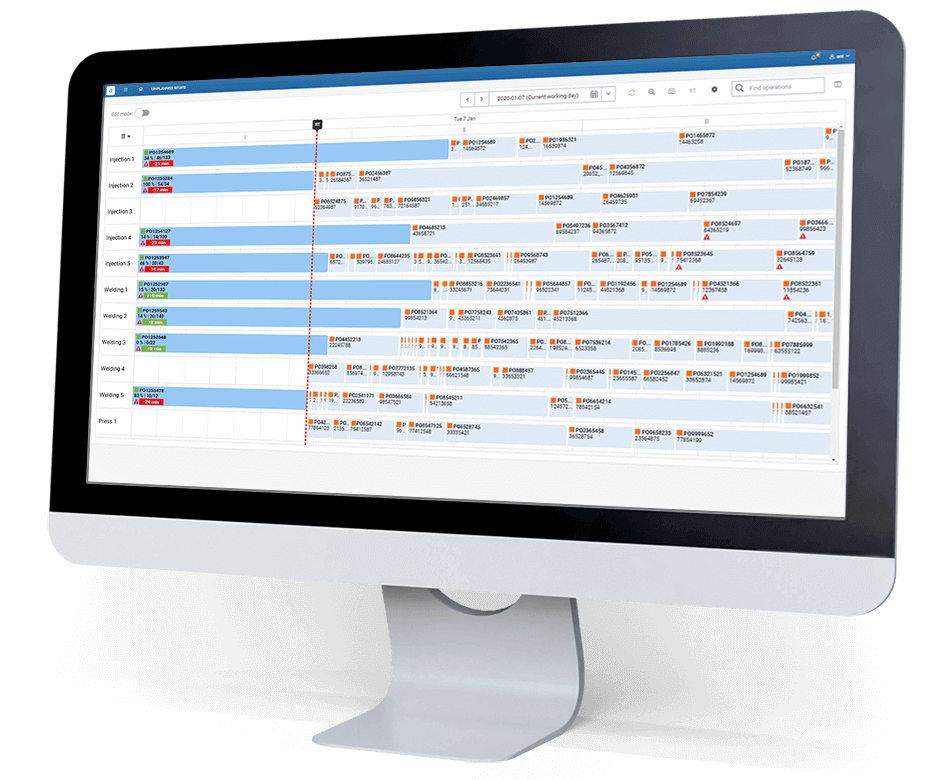
Orders arrive from ERP, are sequenced against takt and demand, and are dispatched to stations with the right routing, BOM and work instruction revision for each unit. Explore the module ➤
Serial numbers, component batches and containers are matched to the unit as it moves. Scan a finished part to find everything in it, or a raw material to find every part it went into. Explore the module ➤
In-process checks with immediate in-limit or out-of-limit verdicts, read from automation or entered by the operator, with Shewhart control charts monitoring process stability. Explore the module ➤
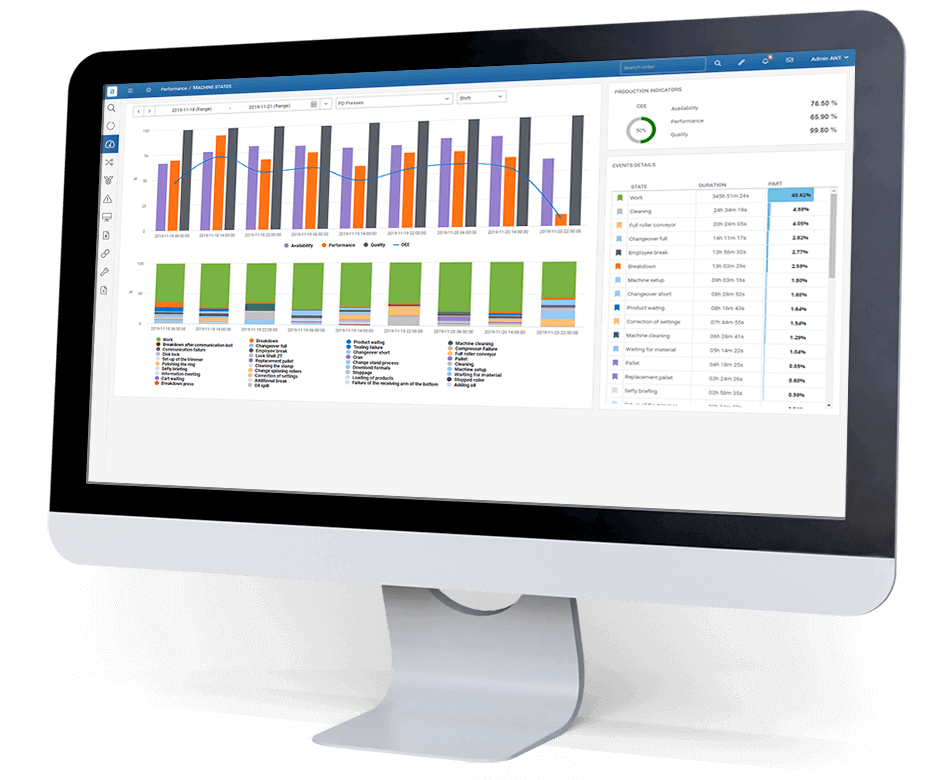
Availability, performance and quality calculated live from PLC signals, with microstops detected automatically and losses ranked by cost on a loss tree. Explore the module ➤
Approved instructions, drawings, photos and video delivered at the station in the context of the current unit – the revision that applies, and only that revision. Explore the module ➤
Line-side calls for maintenance, tooling or materials with automatic escalation and response-time measurement, feeding preventive plans in CMMS. Explore the module ➤
A traceability system earns its cost on the day something goes wrong. The question is never “do we have records?” – it is “can we bound the problem in hours, and prove the bound?” Accevo builds the genealogy continuously as the unit is produced, so containment is a query rather than a project.
From a finished unit you can reach every component batch, tool, machine, parameter set and operator involved. From a suspect material lot you can reach every unit it entered and where each one shipped – which is what turns a potential full-population recall into a bounded one.
Torque values, press forces, weld currents, test results and leak-test outcomes are read from the equipment and attached to the specific unit, not to the shift. The record is contemporaneous and attributable by construction.
Serial number generation, label printing and container identity are handled in the same system, so customer-specific labelling rules and packaging instructions travel with the order.
The cheapest defect is the one the system refuses to let happen. Accevo validates the material, the tool, the program and the measured result at the moment of the operation – so the reject is caught at the station instead of at end-of-line test, or worse, at your customer.
The scanned component is checked against the bill of materials for that specific unit before the operation can proceed. Wrong part, wrong revision or wrong lot simply does not pass.
Critical characteristics are measured, judged against limits and charted continuously. Drift towards a control limit raises an alert while the process is still capable.
Rejects are classified at the station, routed for rework or scrap, and linked to the parameters and materials present at the time – the raw input for a credible 8D.
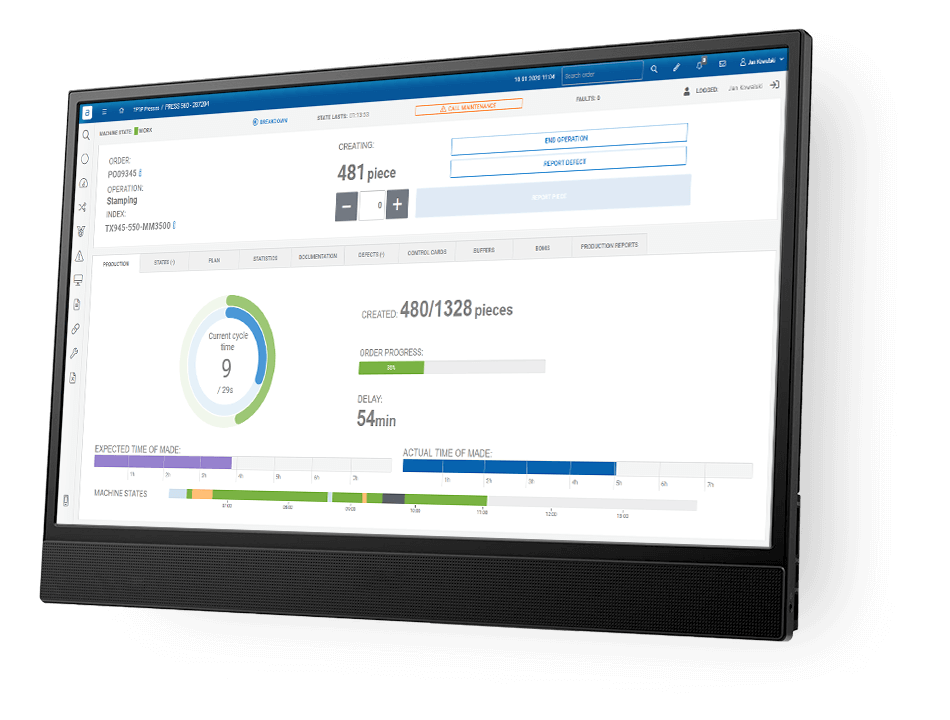
In automotive the money is usually in the minutes around production rather than in production itself: launching a new order, changing a format, waiting for a setting to be verified. Accevo removes most of that time by sending machines their own settings and by proving the setup electronically.
Programs, recipes and setpoints are transmitted to machines and robots from the production order, so a changeover starts with the equipment already configured correctly.
First-off checks and setup approvals are completed on screen against the control plan, with the result recorded and the line released only when the checks pass.
Standardised changeover sequences with measured durations per product pair, so scheduling reflects the real cost of each transition rather than an average.
Material calls are triggered from the line when a station approaches its reorder point, keeping just-in-time supply flowing without stock piling up at the station.
Electric drive production changed the risk profile: high-voltage components, battery modules, cell contacting and power electronics all carry traceability and safety requirements that a paper traveller cannot carry. Accevo treats an e-drive assembly line the same way it treats a combustion line – every parameter attached to a serial number – which is why the transition needs no new system.
Cell, module and pack genealogy with parameter capture at every joining, testing and sealing step.
Electrical test results, insulation checks and safety interlocks recorded against the specific unit.
Mixed manual and automated stations under one execution model, from winding to end-of-line test.
Face an IATF 16949 audit with evidence that already exists. Control plan characteristics are measured in-process, deviations are contained at the station, and traceability queries return in seconds rather than days.
See takt attainment, station-level losses and current OEE while the shift is running, with Andon calls escalating automatically when a station stops.
Comparable performance across lines, plants and customer programmes – and the launch, changeover and quality-cost numbers that justify the next investment.
Bring us one line: the stations, the controllers, the customer requirements and the documentation you currently keep on paper. We will show you exactly which signals we can read today, what traceability record that produces, and where the launch and changeover time is actually going.
Our own automation engineers do the connection work – wiring, gateways and edge devices included – so you are not coordinating a software vendor and an integrator against each other.