

A Laboratory Information Management System (LIMS) is software for managing laboratory samples, tests, results and the records that connect them. It gives a sample an identifiable path from receipt through testing, review and reporting. In manufacturing, quality laboratories may use LIMS to manage incoming-material, in-process and finished-product tests.
A LIMS is more than a results database. Its value depends on clear sample identities, approved methods, controlled workflows and reliable links between people, instruments, specifications and decisions.
How does a LIMS work?
The exact workflow varies by laboratory, but a typical sample moves through five stages:
- Register: record the sample ID, source, collection or receipt time, material or product, and requested tests.
- Assign: select the approved method, specification, analyst, due date and any required preparation.
- Capture: enter results or receive them from connected instruments, preserving units, timestamps and context.
- Review: check completeness, calculations, limits, exceptions and any investigation before approval.
- Report: release an authorised result or certificate and retain the record according to policy.
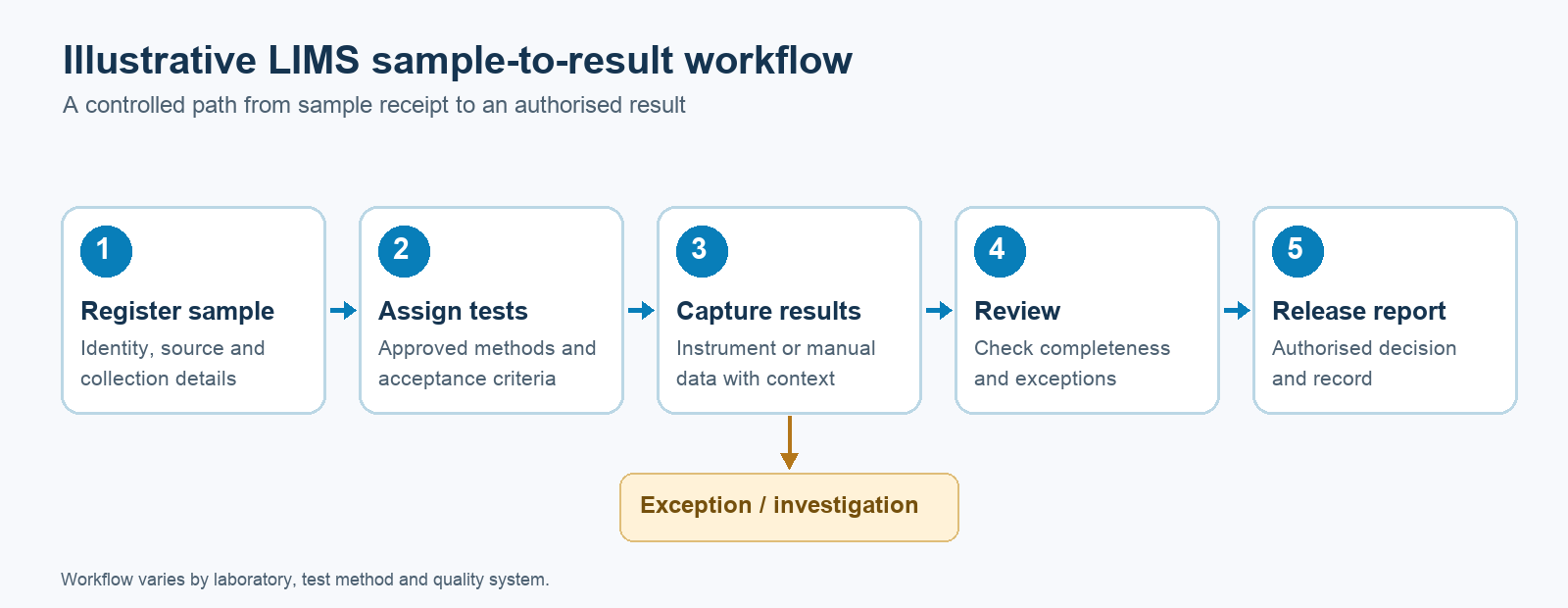
A sample that fails a specification is not simply changed to “pass.” The laboratory follows its approved procedure for investigation, repeat testing where justified and disposition. LIMS can keep the sample, original result, subsequent work and approvals connected.
What information can a LIMS manage?
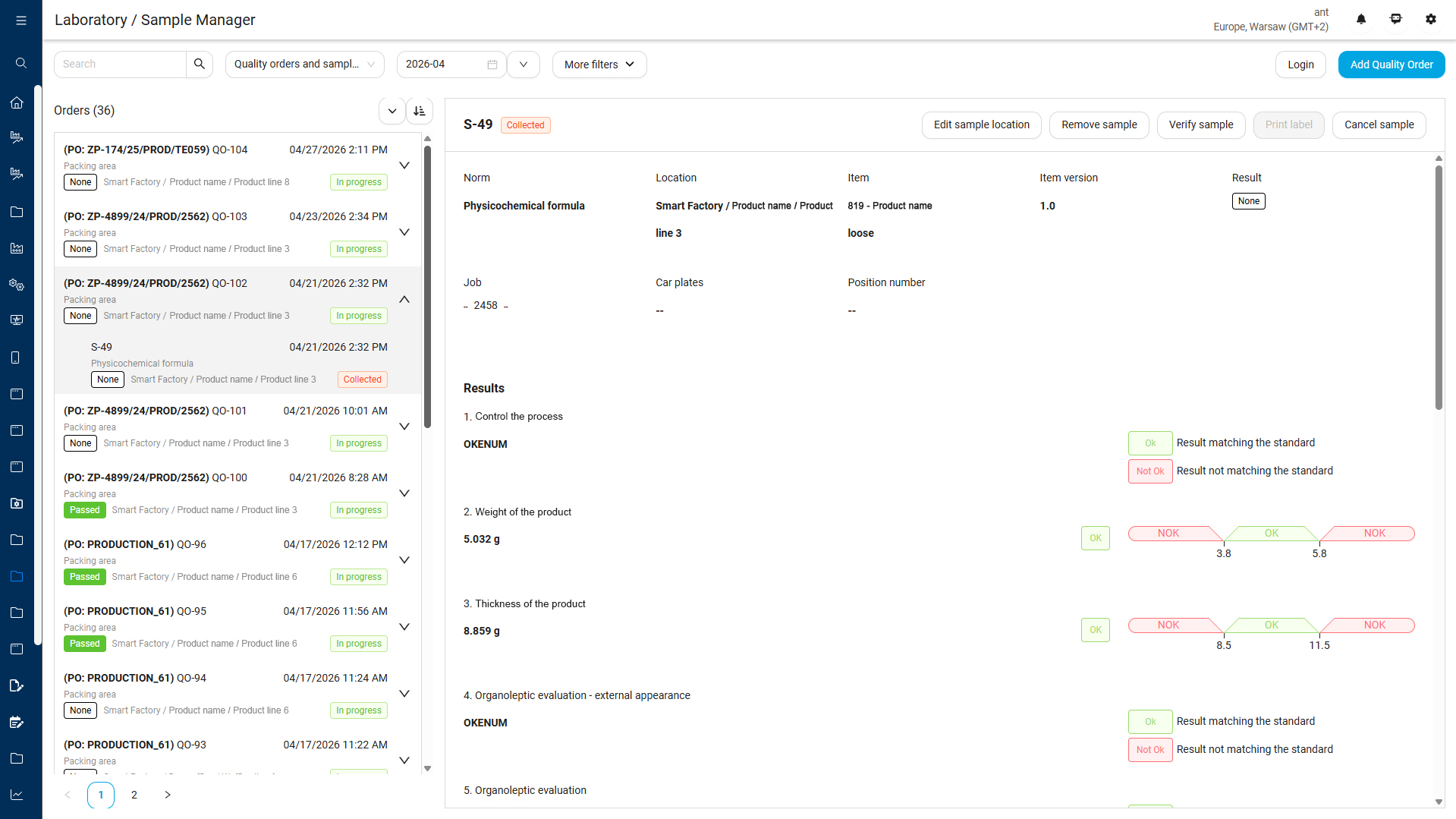
Depending on the implementation, a LIMS can hold sample locations and status, test requests, method versions, instrument and reagent details, raw or calculated results, specifications, review actions, audit history and reports. Some laboratories also use it for stability studies, environmental monitoring, inventory or instrument scheduling. These are implementation choices, not universal features of every LIMS.
LIMS compared with MES, EBR and ELN
A Manufacturing Execution System (MES) coordinates and records production work on the shop floor. LIMS focuses on laboratory samples and test results. An electronic batch record (EBR) brings together the production evidence needed for a batch review; it may receive approved quality results from LIMS. An electronic laboratory notebook (ELN) is commonly used for experiment notes and scientific work, while LIMS usually centres on structured sample and test workflows. The boundaries can overlap, so assess the actual functions and data ownership of each system.
Benefits and limits of LIMS
- Traceability: follow a sample and its test history from receipt to authorised report.
- Consistency: use controlled methods, units, fields and review steps.
- Visibility: see pending tests, exceptions and turnaround status.
- Less manual transfer: instrument and system integrations can reduce re-entry where they are correctly configured.
LIMS does not make a laboratory compliant or its results correct by itself. Poor sample labelling, unsuitable methods, incorrect master data and weak review can still produce unreliable records. The system must support the laboratory’s procedures and quality controls, and staff need to use them.
What should a manufacturer plan before implementation?
Map the journey of a real sample, including relabelling, aliquots, repeats, rejected samples and out-of-specification results. Define sample identifiers, master data, approved methods, roles, result review and reporting rules. Decide which system owns each record and which integrations are necessary with instruments, MES, ERP or EBR. For regulated use, assess validation, access control, audit trails, electronic signatures, backup and retention against the applicable GxP requirements.
For a product-focused overview, see Accevo’s LIMS system. For a general explanation of LIMS workflow, see the CDC’s LIMS introduction.