

QMS Software for Manufacturing
Catch defects at the machine, not at the customer. Accevo QMS is quality management system software that runs quality control where production happens – inspections at the operator panel, SPC in real time, NCR and CAPA workflows that actually close.
Built for manufacturing quality management under ISO 9001, IATF 16949, ISO 13485 and GMP, and connected to your MES, EBR and lab so quality data never has to be re-entered.


What is QMS software?
A Quality Management System (QMS) is the framework of policies, processes and records an organisation uses to deliver consistent quality. QMS software digitalises that framework: it defines the quality control plan, captures inspection results, routes non-conformances, drives corrective actions and proves to an auditor that every step happened.
Quality control software focuses on inspecting and testing product. A quality management system software platform is broader – it covers quality planning, control, assurance and continuous improvement as one closed loop. Accevo QMS for manufacturing includes QC capabilities inside that larger system, so a failed measurement at a workstation becomes a documented, tracked, and closed action rather than a note on a clipboard.
Quality management challenges this solves
Quality on paper and in spreadsheets means results arrive too late to act on. Defects are found at final inspection or by the customer, root causes are argued rather than measured, and audit preparation becomes a project of its own.
Digital manufacturing quality management moves the check to the moment of production. Out-of-spec values are flagged as they are measured, blocked material cannot move, and every corrective action has an owner and a due date.
Problems we hear before implementation:
- Defects discovered at final inspection, when scrap and rework are most expensive
- Non-conformances tracked in email and spreadsheets, with CAPAs that quietly never close
- Audit preparation costing weeks of hunting for records across plants and departments
- No comparable quality data between plants making the same product
What changes after:
- Inspections at the operator panel with instant in/out-of-spec verdicts and enforced reaction
- NCR and CAPA workflows with owners, deadlines and effectiveness checks built in
- Audit evidence generated continuously - reports and trails ready on the day, not after
- One quality data model across every plant, so benchmarking is finally meaningful
Key features of Accevo QMS
The functions a quality team actually uses daily – inspection, non-conformance handling, corrective action, statistical process control and audits – in one manufacturing quality management platform.
Quality inspections & control plans
Control plans define what is checked, when, by whom and against which limits. Inspections run at incoming goods, start of production, in-process and final release, with results captured at the operator panel or read directly from measuring equipment.
NCR - non-conformance management
Every deviation raises a non-conformance report with the full production context attached: batch, machine, operator, parameters. Affected material is blocked automatically so nothing suspect moves downstream.
CAPA - corrective & preventive actions
Non-conformances trigger structured corrective actions with root cause analysis, assigned owners, deadlines and effectiveness verification – so a CAPA closes because it worked, not because time passed.
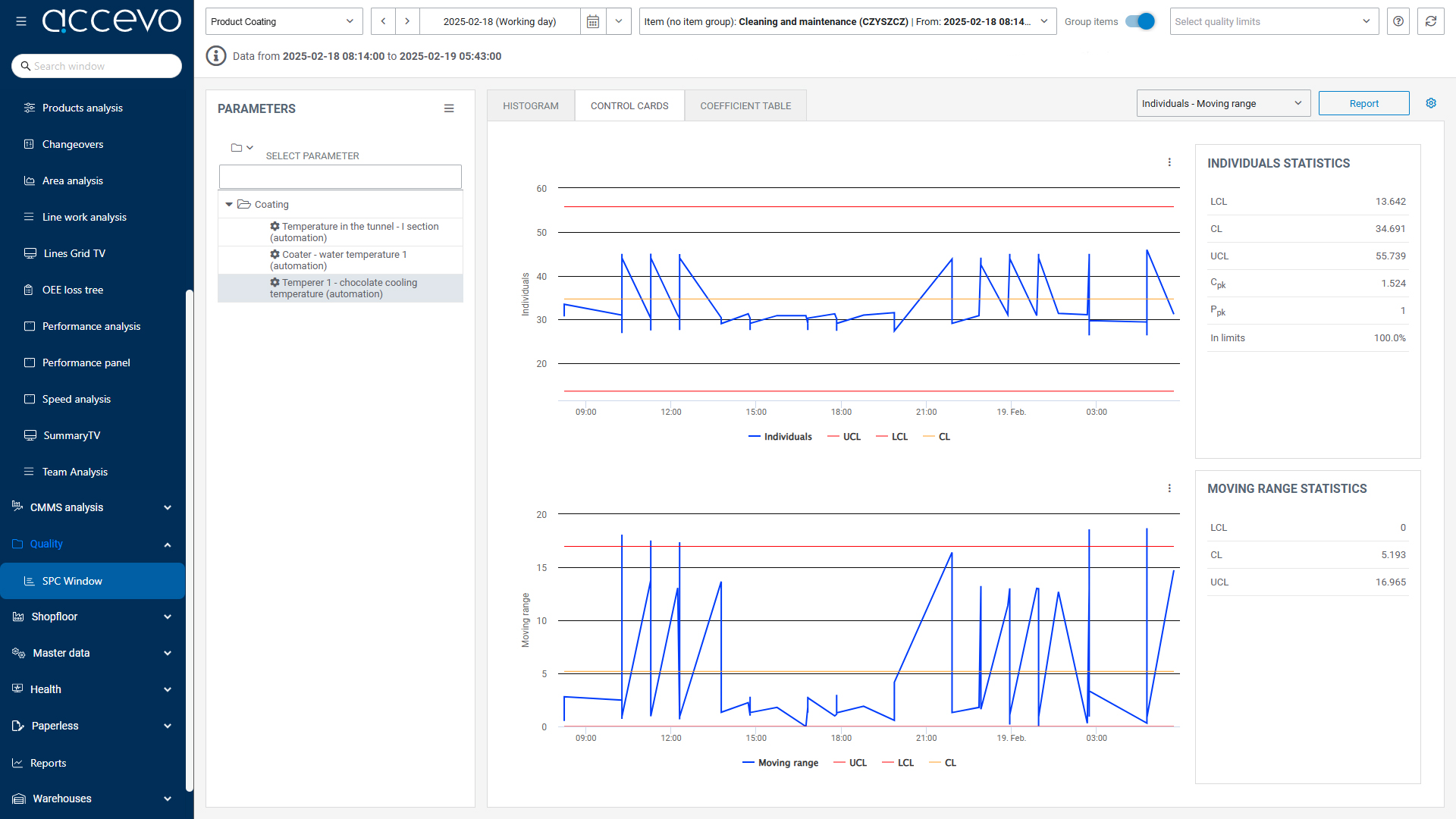
SPC & control charts
Statistical process control with Shewhart control charts and capability indices monitors stability continuously. Drift is visible before it becomes a defect, from automatic or manual measurements.
Audit management
Plan, execute and analyse internal audits – product, process, 5S and TPM – with findings feeding straight into the CAPA workflow and a permanent record for external auditors.
Supplier quality & metrology
Incoming inspection plans, Certificate of Analysis (CoA) handling and supplier scorecards that compare quality at supplier and customer side. Calibration management keeps every gauge in date.

Defect management & statistical process control
Defect templates map every failure mode you care about, so operators classify problems consistently instead of writing free text nobody can aggregate. That consistency is what makes the analytics work: Pareto by defect type, by machine, by shift, by supplier – the data that tells you where to spend improvement effort.
Underneath, statistical process control watches the measurements themselves. Control charts reveal drift, oscillation and shifts in mean long before a part goes out of tolerance, and rework and scrap are costed automatically so the quality conversation with operations is about money, not opinions.
Compliance management: ISO 9001, IATF 16949, GMP
Standards differ by industry, but the demand is the same: documented processes, traceable records and provable corrective action. An ISO 9001 QMS software foundation covers the core; industry layers add what your auditor asks for.

ISO 9001
The core quality management standard: documented processes, quality policy and objectives, monitoring against those objectives, and continuous improvement. Accevo QMS maintains the records, audit trails and reports certification requires.
IATF 16949 & ISO 13485
Automotive adds control plans, PPAP-grade evidence and rigorous SPC; medical devices (ISO 13485) add design and risk records with full device traceability. Both build on the same digital quality backbone.
GMP & cGMP
For pharma and food, quality records must be ALCOA+ with electronic signatures and audit trails under FDA 21 CFR Part 11 – delivered together with Accevo EBR for batch-level compliance.
Integration with MES, EBR and your lab
Quality data that lives in its own silo creates work instead of removing it. Accevo QMS runs on the same platform as MES and EBR, so context arrives with the measurement and decisions reach the shop floor immediately.
MES: quality in the production context
Every inspection is linked to the order, batch, machine, tool and operator from Accevo MES. A quality gate can hold production directly – no email, no delay between finding a problem and stopping it.
EBR: quality inside the batch record
In regulated production, in-process checks and deviations are part of the electronic batch record itself, enabling review by exception at release rather than a separate quality file to reconcile.
LIMS & ERP
Lab results flow in from Accevo LIMS and analytical equipment such as CMM. ERP supplies master data and receives quality status, via REST/SOAP web services, SAP RFC or flat files.

Quality KPIs & dashboards
Quality improves when it is measured in the same meeting as output. Ready-made dashboards put quality KPIs next to OEE, live and comparable across lines, shifts and plants.
First pass yield & scrap rate
Track FPY, scrap and rework by product, line, shift and plant. Costs are attached automatically, so improvement priorities sort themselves by value rather than by who complains loudest.
Defect Pareto & root causes
Structured defect codes make Pareto analysis instant. Drill from a defect category to the specific machine, batch or supplier behind it in a couple of clicks.
CAPA status & cycle time
See how many corrective actions are open, overdue or awaiting effectiveness checks, and how long the loop takes to close – the honest measure of whether your quality system is working.
Process capability (Cp/Cpk)
Capability indices per characteristic and machine show which processes are genuinely under control and which are passing inspection by luck.
Industries we serve
A quality management system manufacturing teams trust looks different in each sector. Accevo is deployed at Novartis, Sandoz, Servier, Polpharma, Danone, Bahlsen, Reckitt and others – the standards change, the platform does not.
Food, beverage & FMCG
Hygiene and allergen checks, startup checklists per shift, CoA management for incoming ingredients, and fast reaction to deviations on high-speed lines.
Automotive & discrete
IATF 16949 control plans, SPC on critical characteristics, supplier quality management and defect traceability down to the serial number.
Pharmaceutical & life sciences
GMP and cGMP quality records with electronic signatures, deviation handling and full batch traceability, integrated with EBR for release under review by exception.
Tobacco & multi-plant groups
Standardised quality processes across sites, so the same product is checked the same way everywhere - and results are finally comparable between plants.
ROI: what better quality management is worth
The return on QMS software comes from four places, and all four are measurable. Less scrap and rework as defects are caught at the machine instead of at final inspection. Fewer customer complaints and returns, protecting both margin and reputation. Shorter audit preparation, because evidence is generated continuously rather than assembled in a panic. And faster problem resolution, since every non-conformance arrives with its full production context attached. Most plants find the first two alone pay for the system inside a year.
Accevo Pharma MES is built for that reality – batch processing, LIMS integration and real-time quality checks across drugs, vaccines, supplements and cosmetics. You make decisions on real production data and correlate it with utilities usage.

Contact with our Expert
Piotr Kańka, Industrial Software Expert
- A 60-minute online meeting with a dedicated specialist presenting a top system from an industry similar to yours
- Live modeling of your production process
- A budget quotation after the meeting
Frequently Asked Questions
Quality management system software, explained
QMS (Quality Management System) software digitalises the processes and records a manufacturer uses to deliver consistent quality: control plans and inspections, non-conformance reports, corrective and preventive actions, statistical process control, audits and supplier quality - with the documentation needed to prove compliance.
Quality control focuses on inspecting and testing product during or after production. A QMS is broader: it covers quality planning, control, assurance and continuous improvement as one system. Accevo QMS includes QC capabilities as part of that wider framework.
Real-time quality inspections, SPC with control charts, CAPA management, NCR tracking, audit management, supplier quality control and ISO 9001 compliance documentation. Accevo QMS covers all of these, plus lab testing integration through LIMS and defect management with cost analysis.
It automates the documentation, monitoring and reporting ISO 9001 requires: standardised quality processes, complete audit trails, tracked corrective actions and ready compliance reports. Because records are generated as production runs, audits become a review rather than a search.
An NCR (Non-Conformance Report) documents a deviation from specification: what happened, where, and which material is affected. A CAPA (Corrective and Preventive Action) is the structured response - root cause analysis, corrective action, preventive measures and verification that the fix worked.
Statistical Process Control uses control charts to monitor whether a process stays within its natural variation. It matters because it shows drift before parts go out of tolerance - turning quality from inspection after the fact into prevention during production.
Yes. Accevo QMS integrates with MES for real-time shop-floor context, ERP for master data and order management, LIMS for lab testing and EBR for regulated batch production - so quality data flows across the whole production chain without re-entry.
Recent articles

Quality Inspections (SPC)
Quality inspection software that runs checks on the shop floor and flags every deviation in real time – before it turns into a defect.

How to avoid production errors: labelling, validation, and quality gates on production
Achieving high-quality indicators is an essential aspect of ensuring customer satisfaction and promoting further company growth. For this reason, modern production facilities implement further functionalities that focus on increasing accuracy and achieving better results. Fluctuations in quality lead to increased waste and thus additional costs. Wasting resources also hurts the

Bahlsen Polska is enhancing its biscuit factory with an advanced MES system and quality control from Accevo .
Bahlsen, a renowned leader in the biscuit industry, is upgrading its factory in Skawina by integrating a modern Statistical Process Control (SPC) system into its Manufacturing Execution System (MES). This technology solution is being implemented in collaboration with Accevo , a leading company in manufacturing software. Key improvement: Expansion of
Related glossary
Read the definition and practical overview: What is a Quality Management System (QMS)?