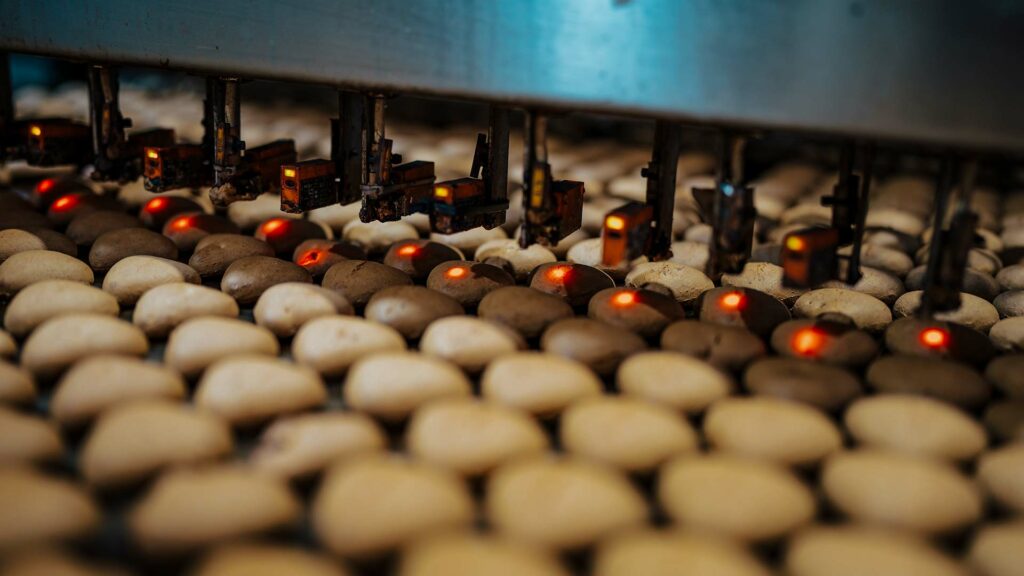
What are the causes of micro-stoppages during the manufacturing process?
Learn about the common causes of micro-stoppages during the manufacturing process and how to address them to improve efficiency and productivity.

Accevo delivers modular software solutions for a wide range of industries, including FMCG, pharma, tobacco and discrete manufacturing.
Every plant loses output to downtime, microstops, inconsistent execution and manual reporting. What differs by industry is which of those hurts most, and what you are obliged to prove afterwards.
Remove waste, reduce stops and improve OEE by 5%
Get rid of micro stops and unnecessary work
A validated system that supports compliance
Reduce waste, errors and improve operations
FMCG manufacturers typically run high-volume lines where performance losses come from stoppages, material waste, short runs, frequent changeovers, and manual reporting gaps. The goal is simple: keep lines stable, reduce losses, and react faster with reliable data. Accevo meets these requirement by providing best in the class solution for FMCG indsutry.
Food & beverage operations often need tight control of process steps, fast deviation handling, and consistent reporting across shifts and lines.
Real-time visibility of line performance and downtime reasons (OEE).
Paperless checks for start-up, hygiene, changeover, and in-process controls (Paperless).
Batch/run traceability and linking quality checks to production context (MES).
Utilities monitoring to identify standby losses and abnormal consumption (EMS).
Packaging lines are highly sensitive to microstops, speed losses, and the quality of changeover execution. Even within a single product family, variations in formats, materials, or configurations can introduce significant complexity at line level.
Microstop and downtime analytics to stabilise throughput (MOM/MES + OEE).
Digital changeover checklists and approvals to reduce variability (Paperless).
Material and label traceability where required (MES).
Tobacco production depends on continuous monitoring, high output stability, and fast detection of the most frequent stoppage patterns. Accevo tobacco solution is a combination of software and hardware setup that monitors processes continuously and improves visibility.
Real-time production visibility across lines and assets (OEE / monitoring).
Stoppage and microstop reduction via loss classification and operator feedback loops (MOM).
Paperless execution records for critical steps (Paperless).
Personal care manufacturing often combines high expectations for product consistency with frequent SKU changes.
Standardised execution and checks to reduce variation (MES + Paperless).
Faster issue escalation with live dashboards and alerts (OEE).
Linking utilities usage and losses to specific runs (EMS).
Household care plants often focus on throughput, waste reduction, and stable performance across multiple lines and product families.
Downtime reduction and improved reporting speed (OEE).
Paperless shift handovers, checks, and exception handling (Paperless).
Execution visibility plus traceability options for materials and process steps (MES).
Pharmaceutical production requires compliant execution, controlled documentation, and consistent enforcement of validated processes across all manufacturing steps. At the same time, production teams must reduce operator administrative burden while ensuring that every action, deviation, and parameter is captured accurately and in real time.
Modern pharmaceutical environments increasingly rely on automated data collection and guided operator workflows to replace manual records and fragmented systems. Electronic Batch Records (EBR) provide the foundation for this approach, enabling structured execution, traceability, and review by exception—while allowing operators to focus on production rather than paperwork.
Discrete environments typically deal with multi-step routing, serial/lot tracking, component validation, complex quality requirements, and frequent engineering changes. Accevo provides workflow instruction software, documentation control and access control modules to facilitate operations on each workstation during the entire assembly process.
Automotive manufacturing requires full traceability of materials, validated production processes, and stable performance across highly automated and mixed-model lines. Compliance with standards such as IATF 16949 depends on consistent execution, reliable data capture, and the ability to analyse production results in real time.
Upstream/downstream traceability of materials, components and tools (MES).
Operator guidance through defined production steps and checks (Paperless/MES).
Performance monitoring to reduce downtime and increase availability (OEE).
Aerospace production requires strict control of documentation, detailed work instructions, and verifiable evidence that each operation has been executed in accordance with approved procedures. Manufacturing processes must support full traceability and ensure that operators always work with the correct and most up-to-date instructions.
Paperless work instructions and digital execution records (Paperless).
Quality checks and inspection records linked to parts/operations (MES).
Traceability options for materials, tools, and process steps (MES).
Assembly operations require clear, step-by-step work instructions, early detection of execution issues, and consistent capture of production and quality data across all stations. Standardised guidance and real-time feedback help ensure repeatable execution, faster problem resolution, and reliable reporting across the entire assembly process.
Â
Digital work instructions, checklists, and approvals at the station (Paperless).
Validation and rework tracking to reduce escapes (MES).
Live visibility of station performance and causes of interruptions (OEE).
Accevo supports a modular, step-by-step implementation model that allows manufacturers to start with immediate operational visibility and expand capabilities as needs evolve. This approach enables faster time to value while keeping the solution aligned with industry priorities and existing system landscapes.
Gain real-time insight into performance, availability, and downtime to establish a reliable operational baseline.
Add production execution, traceability, and in-process quality checks to control how work is performed on the shop floor.
Introduce microstop analysis, deeper automation integration, and digital forms to standardise execution and reduce manual documentation.
Cover energy monitoring, maintenance management, or production planning where operational scope requires it.
Whichever sector you land in, the same foundation applies: we connect any machine on the market with our own automation engineers, integrate with the systems you already run, and scale the same solution from one line to every plant in the group.
OPC UA, direct PLC drivers, I/O modules and custom protocols – any machine on the market.
ERP, WMS, CMMS, QMS and BI integration, delivered end to end by one accountable team.
Piotr Kańka, Industrial Software Expert
Industrial software is the set of systems that plan, execute, record and analyse production on a manufacturing site: machine connectivity and data acquisition at the bottom, execution and quality in the middle, and analytics and reporting on top. It sits between your ERP and your machines.
FMCG and consumer goods, food and beverage, packaging, tobacco, life sciences and pharmaceuticals, automotive, aerospace and aviation, discrete manufacturing and assembly, plus sectors such as building materials, appliances and metals. Each has a dedicated page above.
No. Accevo is one modular platform configured per sector. What changes between industries is which modules are switched on and which compliance layer sits on top - not the underlying data model or the machine connection.
Almost always with OEE visibility on one bottleneck line. It is the cheapest step, has the fastest payback, and produces the data that planning, maintenance, quality and energy modules all need in order to work on anything better than assumptions.
Yes - including old ones. We support OPC UA and DA, MQTT, direct PLC drivers for Siemens, Allen-Bradley, Mitsubishi, Omron, B&R and GE Fanuc, Modbus, plus I/O modules and custom protocols where nothing standard exists. Our own automation engineers do the work.
No. Accevo integrates with SAP, Microsoft, Infor, Oracle and others bidirectionally. ERP keeps planning the business; Accevo runs and records the production and reports back.

Learn about the common causes of micro-stoppages during the manufacturing process and how to address them to improve efficiency and productivity.


The implementation of a MES system is a complex and costly process that requires careful planning and preparation. A key step is to conduct a pre-implementation audit, which will help to identify the needs and capabilities of the organisation and assess whether a MES system is the right solution. A


The successful MES implementation depends on several factors – from the correct implementation of the data being collected to the precise analysis of the information. What should be considered when planning manufacturing process modelling? MES provides a number of advantages in this respect, but a few fundamental principles must be
By providing your email and clicking the “Download a catalogue” button, you agree to receive our newsletter.