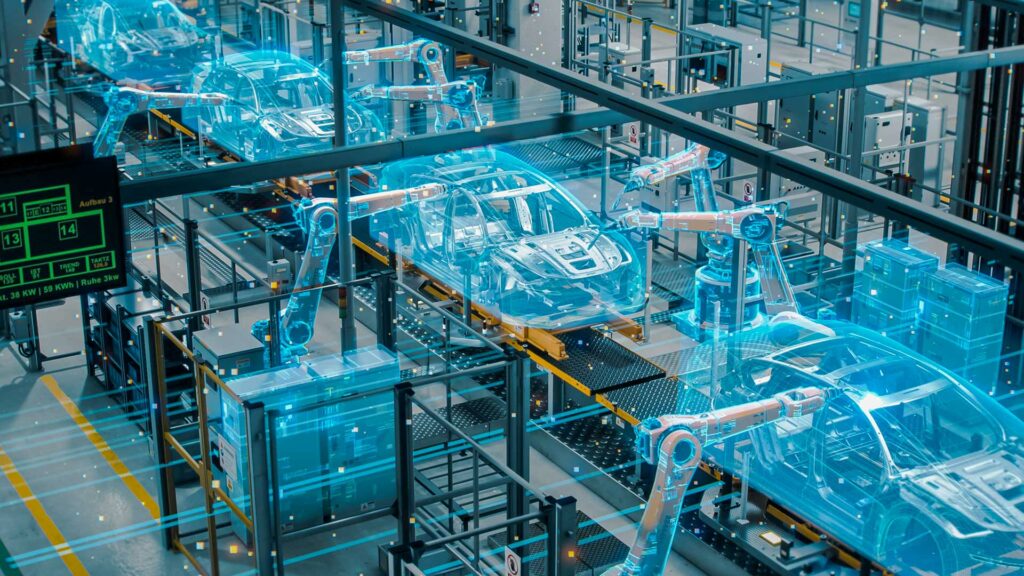
Digitale Transformation in der Fertigung

Start your factory digital transformation project with the step that pays for the next one. This page covers what digital transformation actually means on a shop floor, what it delivers, why most programmes fail, and the nine-step roadmap we use to make sure yours does not.

Written by people who install the hardware. Accevo has delivered hundreds of implementations across automotive, aerospace, FMCG, pharma, electronics and heavy industry – which is also why this page is blunt about the failure modes.

Was ist der digitale Wandel in der Fertigung?

Digitale Transformation in der Fertigung is the process of replacing manual, paper-based and disconnected ways of running production with connected systems that capture what happens automatically and make it usable while it still matters. It ensures a seamless flow of information across the whole production spectrum – machines, operators, quality, maintenance, planning and the business systems above them.

It is worth being precise, because the phrase gets used for everything from a new ERP to a tablet in the warehouse. A factory is digitally transformed when three things are true: production data is captured at source rather than typed in, every function works from the same version of it, and decisions that used to wait for a monthly report now happen during the shift.

Note what is nicht on that list. No digital twin, no autonomous factory, no AI. Those are legitimate later steps, but a plant that cannot yet say why line 3 lost forty minutes last Tuesday is not ready for any of them – and buying them first is the single most reliable way to waste the budget.

56%

Die Befragten gaben an, dass die digitale Transformation, die sie vorgenommen haben, für ihre Pandemiebekämpfung von entscheidender Bedeutung war

94%

Die Befragten geben an, dass Industrie 4.0 ihnen geholfen hat, ihren Betrieb während der Krise aufrechtzuerhalten

Die digitale Transformation in der Produktion gewinnt an Dynamik. Quelle: McKinsey-Studie auf der Grundlage von 400 globalen Fertigungsunternehmen.

56%

call digital transformation essential to crisis response

Reported by manufacturers asked how they responded to recent supply and demand disruption.

94%

say Industry 4.0 helped keep operations running

Manufacturers with Industry 4.0 capability already in place before the disruption began.

89%

of managers agree digitising factories pays off

Plant and operations managers surveyed on the returns from digitising production.

2x

revenue growth for technology leaders vs laggards

Revenue growth among technology-intensity leaders compared with laggards (HBR).

What digital transformation delivers

Ten benefits get listed on most vendor sites, ours included. They fall into three groups, and it is worth knowing which group your board actually cares about before you build the business case.

Output and cost

Operational efficiency and less downtime – losses become visible, ranked and attributable, so the improvement effort goes where the minutes actually are.

Vorausschauende Wartung – condition and usage data turns maintenance from a calendar exercise into a targeted one, cutting both failures and unnecessary interventions.

Production flexibility – shorter changeovers and better sequencing, which is what makes a high-mix order book profitable rather than merely possible.

Quality and control

Verbesserte Produktqualität – parameters checked in-process against limits, so the deviation is caught at the station instead of at final inspection.

Datengestützte Entscheidungen – one number that operations, quality and finance all accept, which removes most of the argument from the morning meeting.

Supply chain visibility and compliance – traceability, genealogy and audit evidence produced as a by-product of production rather than as a separate exercise.

People, energy and resilience

Workplace safety and better work – fewer manual transcriptions, clearer guidance at the panel, and less time spent reconstructing what happened.

Reduced environmental impact – energy correlated with actual production, so the consumption per unit becomes something you can manage rather than merely report.

Competitive resilience – 94% of manufacturers surveyed say Industry 4.0 capability helped them keep operating through recent disruption.

Digitale Transformation zahlt sich aus

DG
Bei 150 Unternehmen aus verschiedenen Branchen wurde festgestellt, dass das Umsatzwachstum und die durchschnittliche jährliche Wachstumsrate bei den Spitzenreitern (oberstes Quartil) in Bezug auf die Technologieintensität mehr als doppelt so hoch waren wie bei den Schlusslichtern (unterstes Quartil). Quelle: HBR Mai-Juni 2022
89%

89% of Managers Agree That Digitising the Factory Brings Multiple Benefits to the Production. Operational efficiency and better decision-making were the two most frequently cited factors.

Why digitisation of production plants fails

The uncomfortable pattern: the technology almost never fails. Programmes fail because they were scoped as a technology rollout rather than as the removal of a specific, measured loss – so there is no moment where anyone can point at a number and say it worked.

The successful version is smaller and less exciting. One line, one loss, measured before and after, then extended once the result is undeniable. It also has a named owner inside the plant, not only inside IT.

Why programmes fail:

What makes them work:

How to start your production digitalisation: the roadmap

Nine steps, in this order, because each one produces the data the next one needs. Plants that follow the sequence tend to keep going; plants that jump to step 5 tend to come back to step 2 eighteen months later having spent the budget.

01

Establish the factory network

Industrial network, segregation between the OT machine network and the IT factory network, VPN and server or cloud environment. Unglamorous, and everything above it depends on getting it right.

02

Connect machines, start with OEE

Machine data acquisition and automatic OEE calculation on the bottleneck line – including the old equipment. Any machine on the market.

03

Analyse the data

Loss trees, Pareto ranking, microstop detection and reporting – turning the raw stream into a costed, ordered list of what to fix first.

04

Implement MES

Order execution, material validation, traceability and in-process quality on the shop floor, reporting back to ERP automatically.

05

Add planning and maintenance

Advanced planning and scheduling built on real measured changeover times, then CMMS maintenance management driven by actual equipment condition and usage.

06

Go paperless, then measure energy

Digital documentation and work instructions across the floor, and finally energy consumption correlated with real production output.

Which system should you start with?

Almost always the one that measures. It is the cheapest, it is the fastest to show a result, and every other module on the roadmap is guessing without it. The three questions below usually settle the discussion in one meeting.

Can you say where the capacity went?

If the honest answer is “roughly, from the shift report”, start with machine connectivity and OEE. You will find losses in the first fortnight that nobody knew existed – typically microstops and changeover time – and they cost nothing but attention to remove.

Can you prove what you produced, and how?

If traceability, batch records or customer audits are the pressure, start with MES and paperless documentation. In regulated plants this is usually the step that pays for the programme on its own.

Is the constraint planning rather than execution?

If the lines run well but the schedule never survives contact with reality, APS is the right entry point – but it needs real measured changeover and cycle times, which means step 2 comes first anyway.

Which industries benefit from factory digital transformation?

All of them, but not equally and not in the same order. What differs is which loss dominates and what you are obliged to prove afterwards.

FMCG, food, beverage and pharma

Speed and compliance in different proportions. FMCG lives on OEE, microstops and changeover; pharma on validated systems, batch records and review by exception.

Automotive, aerospace and defence

Traceability and configuration control are contractual, not optional. Automotive runs on IATF 16949 and takt-time discipline; aerospace on AS9100, revision control and a thirty-year product life.

Electronics, semiconductors and heavy industry

High mix, long cycles and expensive assets, where equipment reliability and process parameters matter more than raw line speed. See discrete manufacturing.

The challenges - and what to do about them

Every one of these is real, and every one of them is manageable if it is named at the start rather than discovered in month four. The four below account for most stalled programmes we are asked to rescue.

High initial investment

Answer it by scoping small. One line, one module, a measured result inside a quarter – then let the number argue for the next phase instead of a business case built on assumptions.

Skills gaps and change resistance

The system has to remove work from operators, not add it. Where it does, adoption follows. Where it does not, the data quietly stops being accurate – and a Center of Excellence inside the plant is what keeps that from happening.

Legacy system and machine integration

The most common project-killer, and the most avoidable. Do the automation assessment from the real PLC list before contracts are signed, not after. Old machines are connectable; unassessed ones are expensive.

Cybersecurity and data governance

Segregated OT and IT networks, authenticated and encrypted access, and a supplier who can show certification. Accevo holds ISO 9001, ISO/IEC 27001 and ISO 22301.

Project timeline and what to secure before you start

A first deployment on one line is typically 2-8 weeks; a group rollout on a proven model solution runs to about two months per factory. Most of the slippage risk sits before the software, in the three things below – so secure them early and the rest is schedulable.

Network, servers and access

Industrial network, OT/IT segregation, VPN, and the server or cloud environment. Cloud, on-premise or hybrid – decided before kick-off, not during.

The PLC list and machine documentation

The single most valuable document in the whole project. It determines the connection method for every asset and turns the automation assessment from discovery into planning.

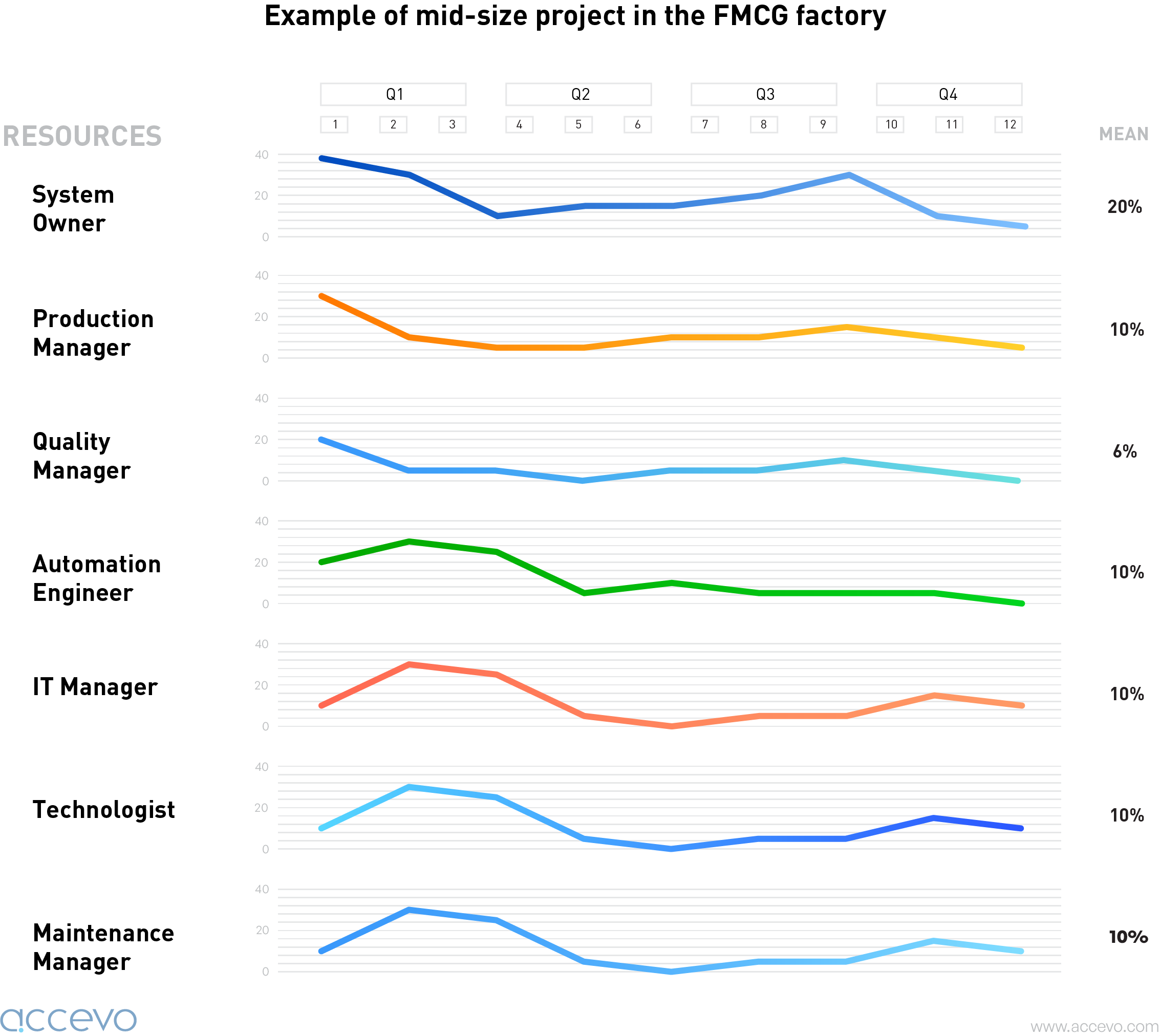
A production owner and a project team

Project manager, automation, production, technology and quality, plus logistics. An IT-only project team is the most reliable predictor of a stalled programme.

DG chart

Why choose Accevo as your transformation partner

Three reasons the shortlist usually comes down to who does the automation work, not who has the best dashboard.

We connect any machine - ourselves

Leading machine connectivity, delivered by our own automation engineers including hardware, wiring and gateways. No subcontracted integrator, no machines quietly dropped from scope, one party accountable from the PLC to the dashboard.

Independent, agile and configurable

An independent software provider, so the recommendation is not steered by a hardware vendor’s catalogue. Configuration rather than custom code covers most of what other suppliers quote as development.

Quick to implement, built to scale

A first line live in weeks, a group rollout at roughly two months per factory on a model solution, and one integrated platform underneath – part of the Dürr Group, with hundreds of implementations behind it.

Starten Sie Ihr Projekt zur digitalen Transformation

Bring us the concrete version: one line, its losses, your documentation flow, your PLC list and the systems you already run. In 60 minutes we will show you a comparable system from your industry, model your process live, and follow up with a budget quotation.

If you would rather understand the software landscape first, our Industry 4.0 software page covers the categories, and the industry pages cover what changes by sector.

accevo cloud

Häufig gestellte Fragen

Digital transformation in manufacturing, explained

Digital transformation in manufacturing is the process of replacing manual, paper-based and disconnected ways of running production with connected systems that capture data automatically at source. A plant is transformed when production data is captured rather than typed, every function works from the same version of it, and decisions happen during the shift rather than after a monthly report.

Higher operational efficiency and less downtime, lower costs through predictive maintenance, better and more consistent product quality, data-driven decisions, greater production flexibility, supply chain visibility, lower energy use per unit, improved safety, and the compliance evidence produced as a by-product of production.

Rarely for technical reasons. They fail when the programme is scoped from a technology list instead of a measured loss, when the whole plant is attempted in one phase so nothing is provable before the budget review, when legacy machines turn out mid-project to be unassessed, and when the project is owned by IT with no production sponsor.

With the factory network, then machine connectivity and OEE on one bottleneck line. It is the cheapest step, shows a result fastest, and produces the data that planning, maintenance, quality and energy modules all need. Skipping it is the most common expensive mistake.

A first deployment on one line is typically 2-8 weeks depending on complexity and integration scope. Machine connectivity and live dashboards can run within days on standard PLC protocols. A group rollout on an established model solution runs at roughly two months per factory.

Industry 4.0 describes the technological shift - connected machines, real-time data, systems that act on it. Digital transformation is the organisational programme that gets you there: the roadmap, the sequence, the change management and the business case. One is the destination, the other is the journey.

No. Machines of any age can be connected - through modern protocols where they exist, and through converters, gateways or I/O modules where they do not. ERP stays in place and integrates bidirectionally with SAP, Microsoft, Infor, Oracle and others.

Automotive, aerospace and defence, electronics and semiconductors, FMCG including food and beverage, pharmaceuticals and biotechnology, and heavy industry. The benefit is universal; the order of the roadmap is what changes by sector.

Baseline one line before you change anything, remove one measured loss, and compare on the same basis. Most sites find enough hidden loss - usually microstops and changeover time - in the first fortnight to justify the next phase without any capital investment.

Experte Perz

Kontakt mit unserem Experten

Sebastian Perz, Experte für industrielle Software

  • Ein 60-minütiges Online-Meeting mit einem engagierten Spezialisten, der ein Top-System aus einer ähnlichen Branche wie der Ihren vorstellt
  • Live-Modellierung Ihres Produktionsprozesses
  • Ein Budgetangebot nach der Sitzung

Aktuelle Artikel

Wonach suchen Sie?

Melden Sie sich für unseren Newsletter an und laden Sie einen Musterprojektplan herunter

Achtung! Bitte geben Sie Ihre Arbeit E-MailE-Mails von beliebten Domänen wie (gmail, yahoo usw.) werden automatisch gefiltert und erhalten den Musterprojektplan nicht.

Beschleunigen Sie die Effizienz Ihrer Produktion!

Holen Sie sich das Accevo Smart Factory Handbuch.

Indem Sie Ihre E-Mail-Adresse angeben und auf die Schaltfläche "Katalog herunterladen" klicken, stimmen Sie dem Erhalt unseres Newsletters zu.

Meet us at Pharma MES 1 - 2 October 2026 | Berlin, Germany