Trasformazione digitale nel settore manifatturiero

Start your factory digital transformation project with the step that pays for the next one. This page covers what digital transformation actually means on a shop floor, what it delivers, why most programmes fail, and the nine-step roadmap we use to make sure yours does not.

Written by people who install the hardware. Accevo has delivered hundreds of implementations across automotive, aerospace, FMCG, pharma, electronics and heavy industry – which is also why this page is blunt about the failure modes.

Che cos'è la trasformazione digitale nel settore manifatturiero?

Trasformazione digitale nel settore manifatturiero is the process of replacing manual, paper-based and disconnected ways of running production with connected systems that capture what happens automatically and make it usable while it still matters. It ensures a seamless flow of information across the whole production spectrum – machines, operators, quality, maintenance, planning and the business systems above them.

It is worth being precise, because the phrase gets used for everything from a new ERP to a tablet in the warehouse. A factory is digitally transformed when three things are true: production data is captured at source rather than typed in, every function works from the same version of it, and decisions that used to wait for a monthly report now happen during the shift.

Note what is non on that list. No digital twin, no autonomous factory, no AI. Those are legitimate later steps, but a plant that cannot yet say why line 3 lost forty minutes last Tuesday is not ready for any of them – and buying them first is the single most reliable way to waste the budget.

56%

Respondents said the digital transformation they undertook was essential to their pandemic responses

94%

Respondents claim that Industry 4.0 helped them to keep their operations running during the crisis

La trasformazione digitale nella produzione sta prendendo piede. Fonte: Studio McKinsey basato su 400 aziende manifatturiere globali.

56%

call digital transformation essential to crisis response

Reported by manufacturers asked how they responded to recent supply and demand disruption.

94%

say Industry 4.0 helped keep operations running

Manufacturers with Industry 4.0 capability already in place before the disruption began.

89%

of managers agree digitising factories pays off

Plant and operations managers surveyed on the returns from digitising production.

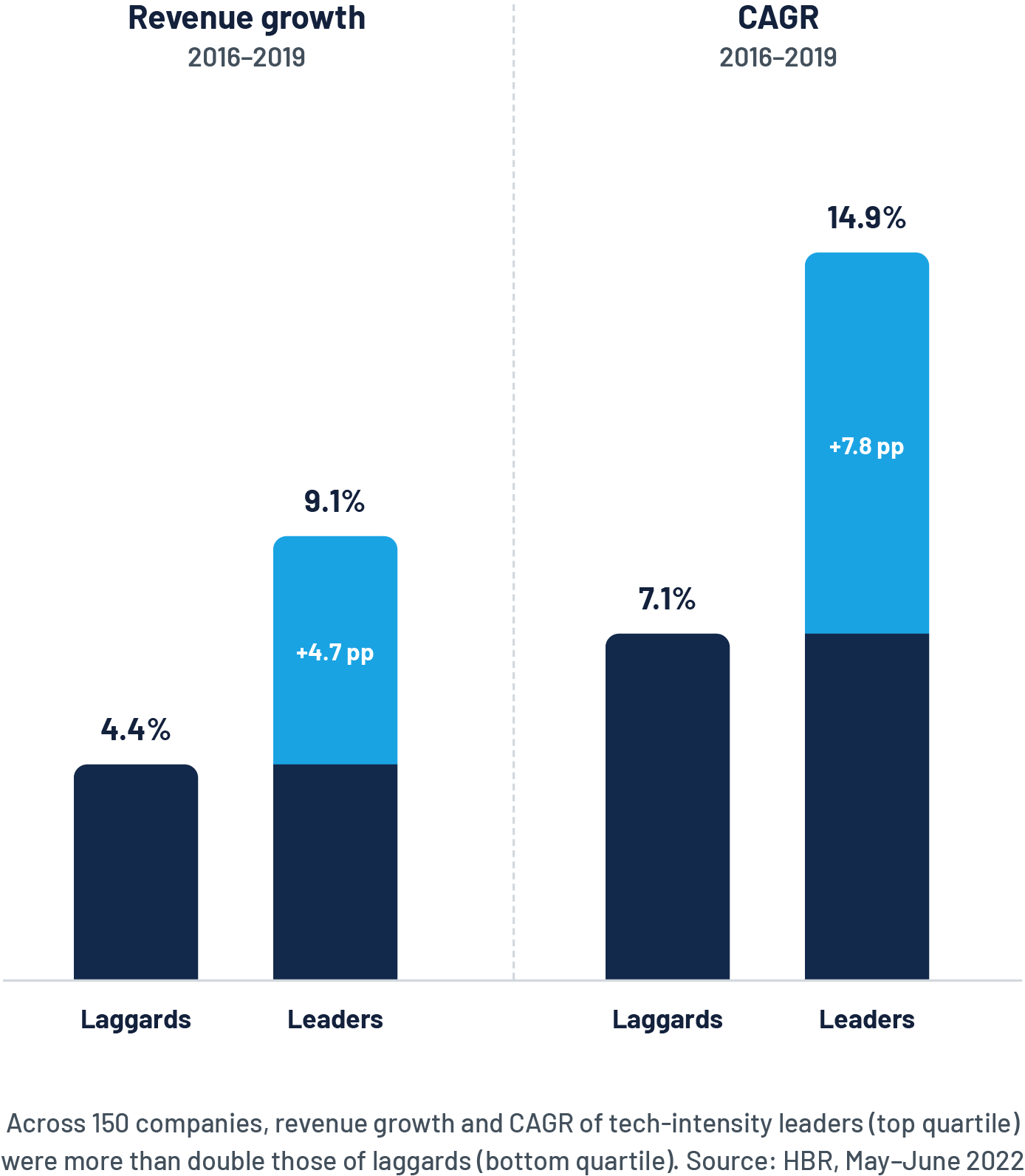
2x

revenue growth for technology leaders vs laggards

Revenue growth among technology-intensity leaders compared with laggards (HBR).

What digital transformation delivers

Ten benefits get listed on most vendor sites, ours included. They fall into three groups, and it is worth knowing which group your board actually cares about before you build the business case.

Output and cost

Operational efficiency and less downtime – losses become visible, ranked and attributable, so the improvement effort goes where the minutes actually are.

Manutenzione predittiva – condition and usage data turns maintenance from a calendar exercise into a targeted one, cutting both failures and unnecessary interventions.

Production flexibility – shorter changeovers and better sequencing, which is what makes a high-mix order book profitable rather than merely possible.

Qualità e controllo

Miglioramento della qualità del prodotto – parameters checked in-process against limits, so the deviation is caught at the station instead of at final inspection.

Decisioni basate sui dati – one number that operations, quality and finance all accept, which removes most of the argument from the morning meeting.

Supply chain visibility and compliance – traceability, genealogy and audit evidence produced as a by-product of production rather than as a separate exercise.

People, energy and resilience

Workplace safety and better work – fewer manual transcriptions, clearer guidance at the panel, and less time spent reconstructing what happened.

Reduced environmental impact – energy correlated with actual production, so the consumption per unit becomes something you can manage rather than merely report.

Competitive resilience – 94% of manufacturers surveyed say Industry 4.0 capability helped them keep operating through recent disruption.

La trasformazione digitale paga

charts
89%

89% of Managers Agree That Digitising the Factory Brings Multiple Benefits to the Production. Operational efficiency and better decision-making were the two most frequently cited factors.

Why digitisation of production plants fails

The uncomfortable pattern: the technology almost never fails. Programmes fail because they were scoped as a technology rollout rather than as the removal of a specific, measured loss – so there is no moment where anyone can point at a number and say it worked.

Why programmes fail:

The successful version is smaller and less exciting. One line, one loss, measured before and after, then extended once the result is undeniable. It also has a named owner inside the plant, not only inside IT.

What makes them work:

How to start your production digitalisation: the roadmap

Nine steps, in this order, because each one produces the data the next one needs. Plants that follow the sequence tend to keep going; plants that jump to step 5 tend to come back to step 2 eighteen months later having spent the budget.

01

Establish the factory network

Industrial network, segregation between the OT machine network and the IT factory network, VPN and server or cloud environment. Unglamorous, and everything above it depends on getting it right.

02

Connect machines, start with OEE

Machine data acquisition and automatic OEE calculation on the bottleneck line – including the old equipment. Qualsiasi macchina disponibile sul mercato.

03

Analyse the data

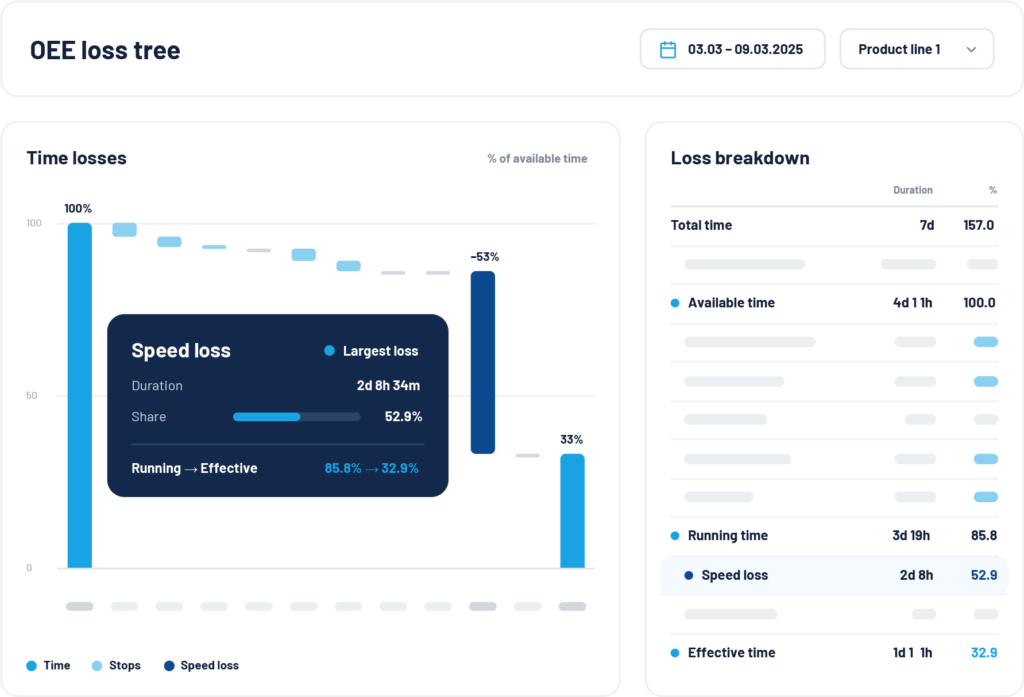
Loss trees, Pareto ranking, microstop detection and reporting – turning the raw stream into a costed, ordered list of what to fix first.

04

Implement MES

Order execution, material validation, traceability and in-process quality on the shop floor, reporting back to ERP automatically.

05

Add planning and maintenance

Advanced planning and scheduling built on real measured changeover times, then CMMS maintenance management driven by actual equipment condition and usage.

06

Go paperless, then measure energy

Digital documentation and work instructions across the floor, and finally energy consumption correlated with real production output.

Which system should you start with?

Almost always the one that measures. It is the cheapest, it is the fastest to show a result, and every other module on the roadmap is guessing without it. The three questions below usually settle the discussion in one meeting.

albero delle perdite OEE

Can you say where the capacity went?

If the honest answer is “roughly, from the shift report”, start with machine connectivity and OEE. You will find losses in the first fortnight that nobody knew existed – typically microstops and changeover time – and they cost nothing but attention to remove.

Can you prove what you produced, and how?

If traceability, batch records or customer audits are the pressure, start with MES and paperless documentation. In regulated plants this is usually the step that pays for the programme on its own.

Is the constraint planning rather than execution?

If the lines run well but the schedule never survives contact with reality, APS is the right entry point – but it needs real measured changeover and cycle times, which means step 2 comes first anyway.

Which industries benefit from factory digital transformation?

All of them, but not equally and not in the same order. What differs is which loss dominates and what you are obliged to prove afterwards.

FMCG, food, beverage and pharma

Speed and compliance in different proportions. FMCG lives on OEE, microstops and changeover; pharma on validated systems, batch records and review by exception.

Automotive, aerospace and defence

Traceability and configuration control are contractual, not optional. Automotive runs on IATF 16949 and takt-time discipline; aerospace on AS9100, revision control and a thirty-year product life.

Electronics, semiconductors and heavy industry

High mix, long cycles and expensive assets, where equipment reliability and process parameters matter more than raw line speed. See discrete manufacturing.

The challenges - and what to do about them

Every one of these is real, and every one of them is manageable if it is named at the start rather than discovered in month four. The four below account for most stalled programmes we are asked to rescue.

High initial investment

Answer it by scoping small. One line, one module, a measured result inside a quarter – then let the number argue for the next phase instead of a business case built on assumptions.

Skills gaps and change resistance

The system has to remove work from operators, not add it. Where it does, adoption follows. Where it does not, the data quietly stops being accurate – and a Center of Excellence inside the plant is what keeps that from happening.

Legacy system and machine integration

The most common project-killer, and the most avoidable. Do the automation assessment from the real PLC list before contracts are signed, not after. Old machines are connectable; unassessed ones are expensive.

Cybersecurity and data governance

Segregated OT and IT networks, authenticated and encrypted access, and a supplier who can show certification. Accevo holds ISO 9001, ISO/IEC 27001 and ISO 22301.

Project timeline and what to secure before you start

A first deployment on one line is typically 2-8 weeks; a group rollout on a proven model solution runs to about two months per factory. Most of the slippage risk sits before the software, in the three things below – so secure them early and the rest is schedulable.

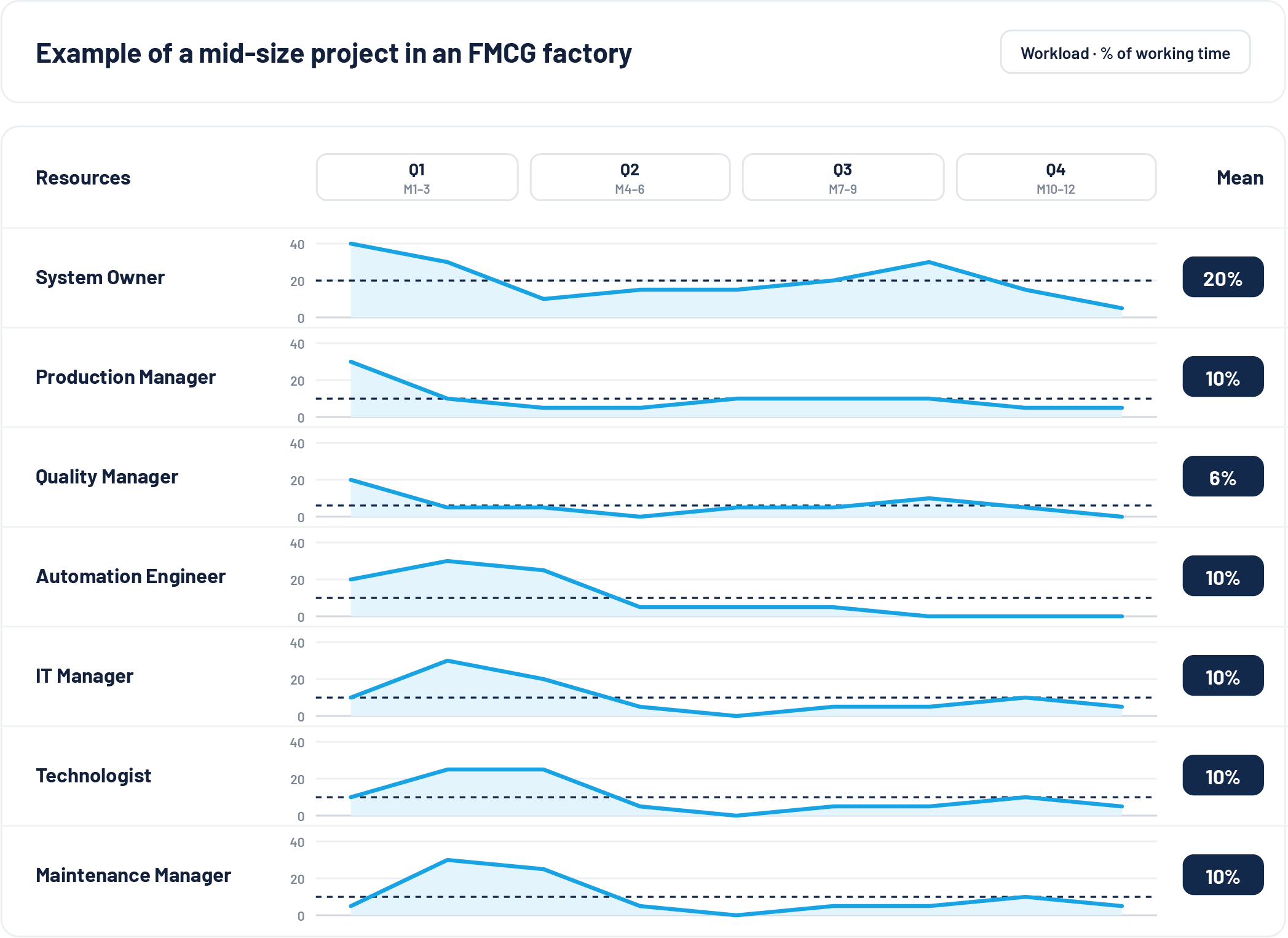
fmcg charts

Network, servers and access

Industrial network, OT/IT segregation, VPN, and the server or cloud environment. Cloud, on-premise o ibrido – decided before kick-off, not during.

The PLC list and machine documentation

The single most valuable document in the whole project. It determines the connection method for every asset and turns the automation assessment from discovery into planning.

A production owner and a project team

Project manager, automation, production, technology and quality, plus logistics. An IT-only project team is the most reliable predictor of a stalled programme.

Why choose Accevo as your transformation partner

Three reasons the shortlist usually comes down to who does the automation work, not who has the best dashboard.

01

We connect any machine - ourselves

Leading machine connectivity, delivered by our own automation engineers including hardware, wiring and gateways. No subcontracted integrator, no machines quietly dropped from scope, one party accountable from the PLC to the dashboard.

02

Independent, agile and configurable

An independent software provider, so the recommendation is not steered by a hardware vendor’s catalogue. Configuration rather than custom code covers most of what other suppliers quote as development.

03

Quick to implement, built to scale

A first line live in weeks, a group rollout at roughly two months per factory on a model solution, and one integrated platform underneath – part of the Dürr Group, with hundreds of implementations behind it.

Avviare il progetto di trasformazione digitale

Bring us the concrete version: one line, its losses, your documentation flow, your PLC list and the systems you already run. In 60 minutes we will show you a comparable system from your industry, model your process live, and follow up with a budget quotation.

If you would rather understand the software landscape first, our Software per l'Industria 4.0 page covers the categories, and the industry pages cover what changes by sector.

Domande frequenti

Digital transformation in manufacturing, explained

La trasformazione digitale nel settore manifatturiero consiste nel sostituire i metodi di gestione della produzione manuali, cartacei e non interconnessi con sistemi interconnessi in grado di acquisire automaticamente i dati alla fonte. Uno stabilimento si considera trasformato quando i dati di produzione vengono acquisiti anziché digitati manualmente, ogni funzione opera sulla base della stessa versione di tali dati e le decisioni vengono prese durante il turno di lavoro anziché in attesa di un rapporto mensile.

Maggiore efficienza operativa e minori tempi di fermo, costi ridotti grazie alla manutenzione predittiva, qualità dei prodotti migliore e più costante, decisioni basate sui dati, maggiore flessibilità produttiva, visibilità sulla catena di approvvigionamento, minor consumo energetico per unità, maggiore sicurezza e la documentazione di conformità generata come risultato indiretto della produzione.

Raramente per motivi tecnici. I progetti falliscono quando la portata del programma viene definita sulla base di un elenco di tecnologie anziché di una perdita quantificata, quando si cerca di realizzare l’intero impianto in un’unica fase, cosicché nulla è dimostrabile prima della revisione del budget, quando a metà progetto si scopre che le macchine esistenti non sono state valutate e quando il progetto è gestito dal reparto IT senza uno sponsor dal lato della produzione.

Con la rete di stabilimento, quindi la connettività delle macchine e l’OEE su una linea che rappresenta un collo di bottiglia. È la fase meno costosa, fornisce risultati più rapidamente e produce i dati necessari ai moduli di pianificazione, manutenzione, qualità ed energia. Trascurarla è l’errore più comune e costoso.

Una prima implementazione su una linea richiede in genere da 2 a 8 settimane, a seconda della complessità e dell’ambito di integrazione. La connettività delle macchine e i dashboard in tempo reale possono essere operativi nel giro di pochi giorni utilizzando protocolli PLC standard. L’implementazione su più linee di una soluzione basata su un modello consolidato richiede circa due mesi per ogni stabilimento.

L’Industria 4.0 descrive la trasformazione tecnologica: macchine interconnesse, dati in tempo reale, sistemi in grado di agire sulla base di tali dati. La trasformazione digitale è il programma organizzativo che consente di raggiungere tale obiettivo: la tabella di marcia, la sequenza delle azioni, la gestione del cambiamento e l’analisi di fattibilità. L’una è la destinazione, l’altra è il percorso.

No. È possibile collegare macchine di qualsiasi età: tramite protocolli moderni, ove disponibili, e tramite convertitori, gateway o moduli I/O, ove non lo siano. Il sistema ERP rimane in funzione e si integra in modo bidirezionale con SAP, Microsoft, Infor, Oracle e altri.

Automotive, aerospace and defence, electronics and semiconductors, FMCG including food and beverage, pharmaceuticals and biotechnology, and heavy industry. The benefit is universal; the order of the roadmap is what changes by sector.

Baseline one line before you change anything, remove one measured loss, and compare on the same basis. Most sites find enough hidden loss - usually microstops and changeover time - in the first fortnight to justify the next phase without any capital investment.

esperto in materia

Contatto con il nostro esperto

Sebastian Perz, Esperto di software industriale

  • Incontro online di 60 minutiti con uno specialista dedicato che presenta un sistema top di un settore simile
  • Modellazione dal vivo del vostro processo produttivo
  • Preventivo dopo l'incontro

Articoli recenti

nuvola bg
Blog

Sfide dell'Industria 4.0 - Cloud o On-Premises?

Nel mondo di oggi, molte aziende si trovano di fronte al dilemma se mantenere un’infrastruttura on-premise o passare a un modello ibrido. Quest’ultima opzione è quasi sempre più complessa, ma quasi sempre vale la pena affrontarla. In questo articolo vedremo perché i progressi in questo ambito sono limitati e cosa possiamo fare noi di Accevo per

Leggi di più ➜
automobilistico 40
Blog

Automotive 4.0: come produrre in modo sostenibile e mantenere i più alti standard qualitativi?

I produttori che operano nel settore automobilistico si trovano attualmente ad affrontare una sfida importante: mantenere la competitività riducendo al contempo l’impatto ambientale dei processi produttivi richiede loro di ricorrere a soluzioni tecnologiche moderne e all’avanguardia. Nell’era dell’Industria 4.0, come è possibile garantire una produzione sostenibile e standard di qualità elevati? Le sfide principali in

Leggi di più ➜

Che cosa sta cercando?

Iscriviti alla nostra newsletter e scarica un esempio di piano di progetto

Attenzione: Si prega di fornire la tua E-mail di lavoroLe e-mail provenienti da domini popolari (gmail, yahoo, ecc.) verranno filtrate automaticamente e non riceveranno il Piano di progetto campione.

Accelerate l'efficienza della vostra produzione!

Ottenere la guida di Accevo Smart Factory.

Fornendo il vostro indirizzo e-mail e cliccando sul pulsante "Scarica il catalogo", accettate di ricevere la nostra newsletter.

Venite a trovarci al Pharma Trackts il 23-24 novembre 2026 | Radisson Blu Hotel Frankfurt