

Agentic AI in manufacturing is software that plans and executes multi-step work across your factory systems. It detects a problem, decides what to do, and takes action, with a human setting the boundaries. Adoption is early but accelerating: in a 2025 Manufacturing Leadership Council survey, 6% of manufacturers said they use agentic AI today and 24% expect to within two years, a fourfold jump. The main bottleneck is rarely the AI model itself, but the state of your production data.
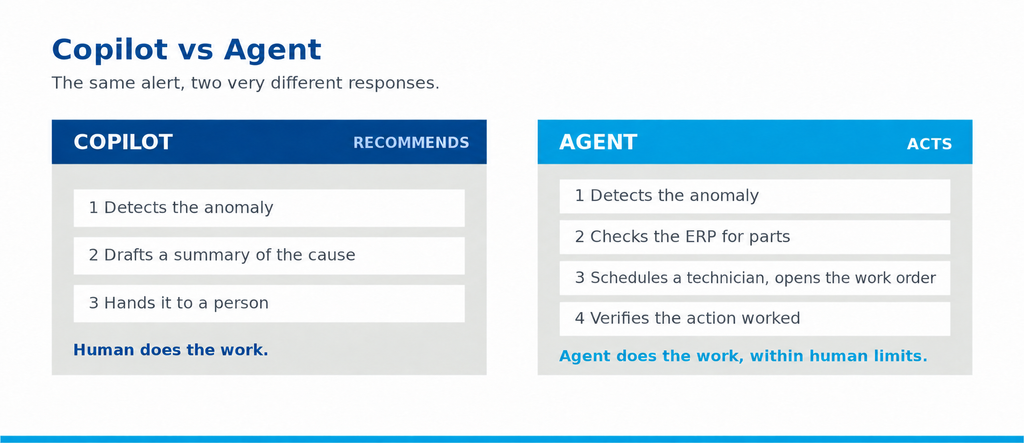
Most factories already have AI. It sits in a dashboard and tells someone that OEE dropped on line 3. Then a human reads the alert, opens a second system to check spare parts, calls maintenance, and writes a work order by hand. The AI advised. The person did the work.
Agentic AI closes that gap. It detects the anomaly, checks the ERP for parts, schedules a technician, and generates the work order, running the full sequence without a person clicking through each step. That is the difference between a copilot and an agent: one recommends, the other acts.
This guide covers what agentic AI in manufacturing actually does today, the maturity levels you should use to size your ambition, the use cases that pay back fastest, the risks that get projects cancelled, and a practical way to start without betting the plant on it.
What is agentic AI in manufacturing?
Agentic AI in manufacturing is a system that pursues a goal by planning steps, making decisions, and executing actions across multiple production systems, with limited human intervention at each step. A traditional analytics tool shows you that a machine is running slow. A generative AI copilot drafts a summary of why. An agent takes the next step on its own: it reorders material, adjusts a schedule, or opens a maintenance ticket, then checks whether the action worked.
The distinction matters because the word “agent” has been stretched thin. A rebranded chatbot is not an agent. A dashboard with a natural-language search box is not an agent. The test is simple: does the software take action in a real system, or does it only produce text for a human to act on?
Three capabilities separate a true agent from an assistant. It perceives, meaning it ingests real-time signals from machines, sensors, and business systems. It decides, meaning it reasons through a goal and picks a course of action. It acts, meaning it writes back to a system that changes what happens on the floor. Remove any one of the three and you have a smarter assistant, not an agent.
Why agentic AI in manufacturing is moving now
The shift is happening because the technology finally reaches into systems that used to be read-only, and because the numbers have started to work.
Adoption data backs this up. In a Manufacturing Leadership Council survey from early 2025, only 6% of manufacturers said they currently use agentic AI, while 24% expect to within two years, a fourfold increase, as cited in Deloitte’s “From vision to value” manufacturing roadmap. The Capgemini Research Institute found that 28% of manufacturers were already running AI agents in production environments in 2025, up from close to zero two years earlier. The broader market is projected to grow from roughly $9.9 billion in 2026 to about $57 billion by 2031.
The payback window is what makes operations leaders pay attention. For narrow use cases like predictive maintenance and vision-based quality control, payback tends to be measured in months rather than years. Those are not decade-long transformation programs. They are payback measured in quarters.
A caution belongs right next to that optimism. Gartner has forecast that over 40% of agentic AI projects will be cancelled by the end of 2027, driven by rising costs, unclear business value, and weak risk controls. The technology works. Most of the failures come from starting in the wrong place.
The five levels of manufacturing AI autonomy
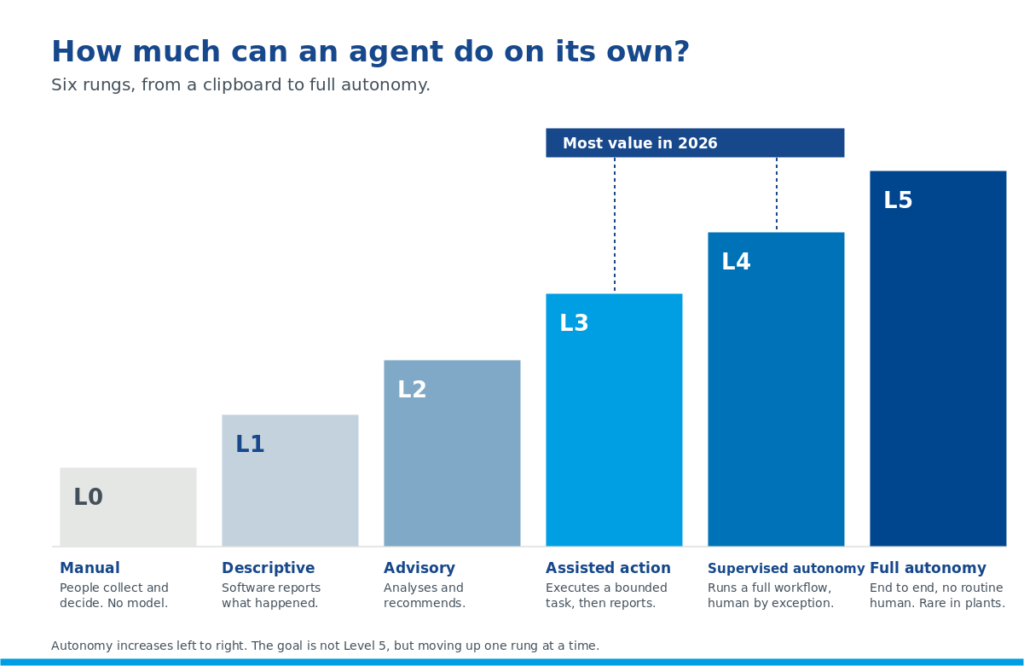
Talking about “AI” as one thing is where most factory conversations go wrong. A vision system that flags a defect and a system that reschedules a whole shift are not the same animal. It helps to think in levels of autonomy, the same way the automotive industry ranks self-driving from assisted to fully autonomous.
Here is a practical ladder for the factory floor.
| Level 0 – Manual | People collect data, read it, and decide. A supervisor walks the line with a clipboard. No model is involved. |
| Level 1 – Descriptive | Software reports what happened. Dashboards show OEE, downtime, and scrap after the fact. The human does all the interpretation and all the action. |
| Level 2 – Advisory | The system analyzes and recommends. It flags the likely root cause of a stoppage or suggests a maintenance window. A person still approves and executes every step. Most factories that say they “have AI” are here. |
| Level 3 – Assisted action | The agent executes a bounded task on its own, then reports back. It opens a work order, reorders a consumable, or adjusts a single machine parameter within pre-set limits. A human reviews the trail and can override. |
| Level 4 – Supervised autonomy | The agent runs a full workflow across several systems, deciding and acting, while a person supervises by exception. It detects a fault, checks parts, dispatches a technician, and updates the schedule. Humans step in only when the agent escalates. |
| Level 5 – Full autonomy | The system manages a process end to end with no routine human involvement. In manufacturing this is rare and, for safety-critical steps, deliberately avoided. |
The point of the ladder is not to reach Level 5. It is to be honest about where you are and to move up one rung at a time. Most of the value in 2026 sits at Levels 3 and 4, in narrow, well-defined workflows.
Where agentic AI works today: use cases by function
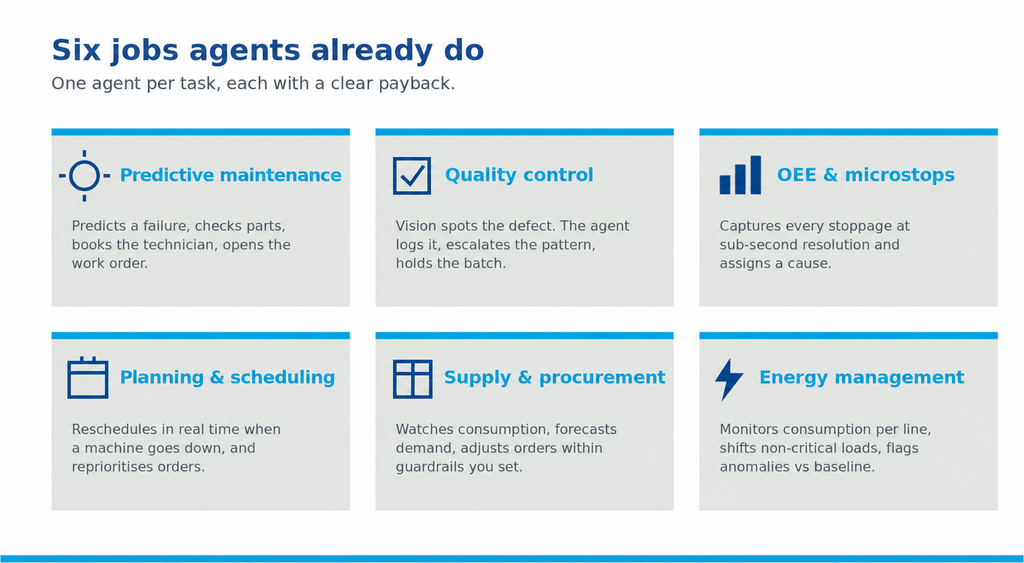
Agentic AI does not arrive as one big system. It shows up as specific agents doing specific jobs. These are the areas where the payback is clearest.
Predictive and prescriptive maintenance
This is the most mature use case. An agent watches machine signals, predicts a likely failure, and then acts: it checks spare-parts availability, books the technician, and generates the work order. The maintenance team stops chasing breakdowns and starts working from a queue the agent has already prepared. In heavy industry, an agent can detect an anomaly, open a service ticket, and trigger technician dispatch in a single sequence.
For this to work, the agent needs maintenance history, real machine-cycle data, and a live parts inventory. Maintenance scheduled on actual machine cycles instead of the calendar is the foundation an agent builds on.
Quality control and defect handling
Computer-vision quality control paired with an agent moves faster than any manual check. The vision model spots a defect, the agent classifies it, logs it, escalates the pattern, and can hold a batch or flag a changeover fault before the next unit runs. This use case pairs with prescriptive maintenance as one of the two fastest to pay back, which is why manufacturers most often start with one of them.
The value grows when defect data connects to genealogy and traceability. An agent that can trace a defect back to a batch, a shift, and a machine parameter does root-cause work that used to take a quality engineer a day.
OEE and microstop elimination
Microstops are the hidden OEE killer. They last one to five minutes, the operator restarts the machine, and the loss never reaches a report. Individually tiny, collectively they eat more availability than big breakdowns, especially on high-speed FMCG lines.
An agent changes the economics here. It captures every stoppage at sub-second resolution, assigns a cause, and surfaces the pattern before it compounds. The bigger shift is what happens to people’s time. When an agent handles the capture and the first-pass analysis, the hours that used to go into compiling stoppage reports go into fixing the stoppages instead.
Production planning and scheduling
Excel scheduling breaks the moment a machine goes down. An agentic planning system reschedules in real time. When a breakdown or a delay hits, it recalculates the plan, validates machine and operator availability, and reprioritizes orders against due dates and penalties, then alerts the planner to the change.
This is a Level 4 candidate: the agent handles the routine reshuffle and escalates only the decisions that carry commercial trade-offs, like which customer’s order slips.
Supply chain and procurement
Autonomous routing and inventory agents have cut inventory and logistics costs by double digits in documented deployments. On the plant side, a procurement agent can watch consumption, forecast demand, and place or adjust orders inside guardrails you set, so the line does not stop for a missing consumable.
Energy management
An energy agent monitors consumption per line and per machine, spots waste, and can shift non-critical loads or flag anomalies against a baseline. As energy costs stay volatile, this moves from a reporting exercise to an agent that acts on tariff windows and demand peaks.
What agentic AI actually needs: the data foundation
Here is the part vendors skip. An agent is only as good as the data and the systems it can reach, and the constraint is rarely the model itself. Most factories run on dark data trapped in silos, where the machine, the ERP, and the quality system do not speak the same language. For most manufacturers, data readiness is the real bottleneck long before model readiness becomes one.
An agent needs three things your factory may not have yet.
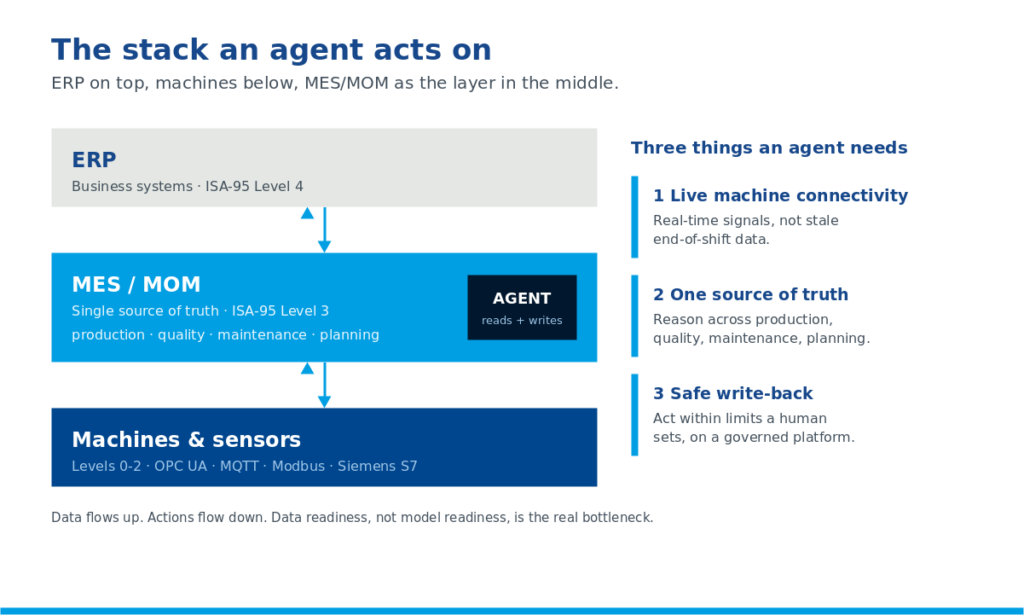
The first is live machine connectivity. An agent that acts on stale, end-of-shift data acts on the past. Real-time signals from every asset, through protocols like OPC UA, MQTT, Modbus, and the Siemens S7 family, are the raw material.
The second is one source of truth. If production, quality, maintenance, and planning data live in separate systems, an agent cannot reason across them. It cannot check parts against a fault against a schedule if those three things live in three databases that do not connect. A unified MES/MOM layer, sitting at ISA-95 Level 3 between the ERP and the machines, is where that single source of truth gets built.
The third is the ability to write back, safely. An agent needs both read and write access to real systems, within limits a human sets. That means work orders, schedule changes, and parameter adjustments must run through a governed platform that enforces those limits.
This is the honest reason MES matters more, not less, in an agentic world. The agent is the driver. The MES is the road, the signals, and the guardrails. Build the agent on top of fragmented data and you get an expensive way to make fast mistakes. Build it on a unified production platform and the agent has something real to act on. Gartner projects that 75% of manufacturers will run MES in the cloud by 2030, up from 38% today, which is the infrastructure shift that makes multi-site agents practical.
The risks worth taking seriously
Agentic AI in manufacturing carries real risk, and pretending otherwise is how you end up among the projects Gartner expects to be cancelled. Four risks deserve a plan before you start.
| Autonomy without oversight | An agent that acts at machine speed can make a mistake at machine speed. Meaningful human oversight means a person can see what the agent is doing in real time and override it. That requires the agent to log its reasoning and its actions, and it requires clear escalation paths for anything high-risk. |
| Data quality | An agent operating on inconsistent data will act confidently on bad inputs. Fix the data foundation before you widen an agent’s authority. |
| Scope creep | The projects that fail try to automate everything at once. The ones that work start with a single, bounded workflow where the cost of a mistake is low and the payback is clear. |
| Security and access | Giving software the authority to change production systems expands your attack surface. Agent permissions belong under the same governance as any other system with write access, aligned with standards like NIS2.None of these are reasons to wait. They are reasons to start narrow, keep a human in the loop, and expand authority only as the agent earns trust. |
None of these are reasons to wait. They are reasons to start narrow, keep a human in the loop, and expand authority only as the agent earns trust.
How to start with agentic AI in manufacturing
The manufacturers who get value do not begin with a plant-wide AI vision. They begin with one line and one problem.
Start by picking a single workflow where the pain is measurable and the risk is contained. Predictive maintenance on one critical machine or microstop detection on one packaging line are proven entry points. Both give you a number to prove.
Prove it on real data before you commit. A proof of concept on one line, using your own production signals, tests the ROI hypothesis in weeks. In our own deployments, a PoC typically runs in about three weeks and rollout readiness follows within three months. The phrase we use for this is start small, scale fast.
Keep the human in the loop at first. Run the agent at Level 3, executing a bounded task and reporting back, before you let it run a full Level 4 workflow. Watch what it does. Correct it. Widen its authority only when the trail shows it deserves it.
Then scale the proven configuration to more lines and sites, rather than rebuilding for each one. This is how a single working agent becomes a plant standard, and then a multi-site standard. The agent is only the visible part; the repeatable rollout is what turns one result into many.
What decides success with agentic AI in manufacturing
Agentic AI in manufacturing is not a far-off idea. It is running in production today, paying back in quarters for narrow use cases like maintenance and quality. The gap between the factories that get value and the ones that cancel the project is not the AI. It is whether the data underneath the agent is real, unified, and live. Get the production platform ready for AI, start on one line, keep a person in the loop, and let the agent earn its authority one workflow at a time.
Want to see what an agent could act on in your plant? The first step is a data readiness check on one line. Book a demo and we will map it against your machines.
Common questions about agentic AI in manufacturing
What is the difference between agentic AI and generative AI in manufacturing?
Generative AI produces content, like a summary of a shift report or a draft root-cause analysis, for a person to act on. Agentic AI in manufacturing takes the action itself: it opens the work order, adjusts the schedule, or reorders the part. Generative AI advises. Agentic AI acts within limits a human sets.
Is agentic AI in manufacturing safe for production environments?
It can be, when it runs with human oversight and bounded authority. Safe deployments keep a person able to monitor and override the agent in real time, log every action, and restrict the agent to a defined scope. Safety-critical steps are usually kept under human control rather than fully automated.
What ROI can manufacturers expect from agentic AI?
ROI depends heavily on data readiness and on starting with a narrow, measurable use case rather than a plant-wide program. The fastest-paying entry points are usually prescriptive maintenance and computer-vision quality control, where payback tends to be measured in months rather than years.
Do I need an MES before I can use agentic AI?
You need a unified source of production data and the ability to act on it safely, which is what an MES/MOM platform provides. An agent has to reason across production, quality, maintenance, and planning data and write actions back into those systems. Without that foundation, the agent operates on fragmented, often stale data.
Which manufacturing use cases are best to start with?
Predictive maintenance on a critical machine and microstop detection on a high-speed line are the most proven entry points. Both are narrow enough to control the risk and produce a clear number to justify wider rollout.
