

Key Takeaways
- ERP handles strategic business planning (inventory, procurement, scheduling); MES handles real-time shop floor execution (machine control, material flow, quality tracking).
- The two systems are complementary, not competing. Integration between them is what unlocks operational excellence.
- Accevo MES connects with major ERP platforms including SAP, Microsoft Dynamics, Omron, and Comarch via web services, database integration, flat files, and SAP connectors.
- Shared master data between ERP and MES ensures both systems operate from the same source of truth, eliminating discrepancies between production plans and actual output.
- Integration delivers measurable ROI through reduced downtime, fewer data entry errors, improved labor efficiency, and faster decision-making.
- Most manufacturers see payback within 12 to 24 months. A phased rollout helps manage costs while accelerating time to value.
- In the context of Industry 4.0, MES-ERP integration is shifting from a competitive advantage to a baseline requirement.
What is ERP and what is MES? – Key Systems In Modern Factory
In modern manufacturing environments, the integration between the Manufacturing Execution System (MES) and the Enterprise Resource Planning (ERP) system is critical for achieving real-time visibility, data consistency, and efficient production control.
ERP (Enterprise Resources Planning) focuses on business-level functions like inventory, procurement, and long-term planning, answering strategic questions about what to produce, when, and with what resources. MES, on the other hand, operates on the shop floor, translating ERP instructions into real-time actions. It monitors machine performance, material flow, and product quality, offering immediate insights into production.
While ERP and MES serve different layers of the manufacturing ecosystem, their integration is essential for achieving operational excellence. ERP handles strategic planning, business processes, and resource allocation, while MES delivers real-time control, visibility, and execution on the production floor.
Together, they enable a fully connected production environment—from forecasting and procurement to execution, tracking, and continuous improvement. Manufacturers that align both systems benefit from improved efficiency, responsiveness, traceability, and decision-making. In the era of Industry 4.0, a strong ERP-MES integration is not just a competitive advantage—it’s becoming a necessity.
The diagram below illustrates how MES acts as the bridge between ERP systems and shop floor operations, enabling seamless data exchange and intelligent execution.
How ERP and MES can integrate together
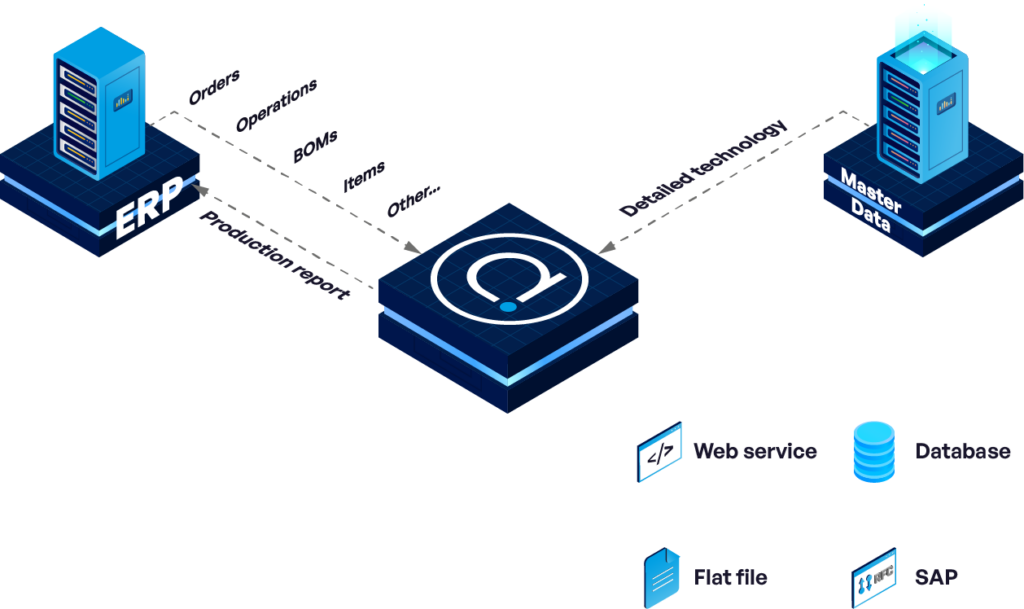
Data Transfer from ERP to MES
The ERP system manages key business data like Orders, BOMs, and production information. This data is transferred to the MES, enabling real-time production management on the shop floor. The MES receives vital information such as production orders, work schedules, material requirements, and detailed technology specifications. Detailed technology includes machine settings, process parameters, and technical requirements that guide the production process. This ensures that production aligns with business needs and technical standards.
MES Manages Production
Upon receiving data from the ERP, the MES takes control of the production process, managing key factors like machine performance, material flow, and labor allocation. The MES uses the detailed technology data to monitor and adjust the production process, ensuring accuracy and compliance with technical specifications. This allows for timely production, inventory tracking, and adherence to quality standards. By syncing with ERP data, MES helps minimize errors and delays, ensuring a smoother operation.
Master Data Synchronization
To maintain consistency, both the ERP and Accevo MES rely on shared Master Data, such as materials and product details. This synchronization ensures that both systems work with accurate, up-to-date information, allowing for efficient resource allocation, scheduling, and real-time production tracking. The shared Master Data prevents discrepancies between production plans and actual manufacturing, ensuring consistency across the two systems.
Seamless Integration with Popular ERP Systems
One of the key advantages of Accevo’s MES is its ability to easily integrate with a wide range of ERP systems, regardless of the platform or provider. Whether you’re using SAP, Omron, Microsoft Dynamics, Comarch, Infor, or any other ERP solution, Accevo ensures smooth connectivity. The system’s flexible architecture is designed to facilitate seamless data exchange, enabling businesses to synchronize their operations effortlessly across different ERP environments.
Whether you use an on-premise ERP like SAP, a cloud-based solution like Microsoft Dynamics, or industry-specific systems like Omron and Comarch, Accevo’s MES ensures seamless connectivity, enabling smooth data exchange between production and business management systems.
Popular ERP Systems in Production Integration
- SAP ERP: Known for its comprehensive functionality, SAP is widely used by large manufacturers. Accevo integrates with SAP ERP to connect production operations with supply chain management, ensuring accurate data flow between the shop floor and enterprise systems.
- Omron: Specializing in manufacturing automation, Omron’s ERP integrates production data with MES systems for enhanced process control. Accevo works seamlessly with Omron, offering real-time production tracking and improving automation on the factory floor.
- Microsoft Dynamics: With its cloud-based architecture, Microsoft Dynamics 365 provides unified capabilities for business operations, from sales to finance. Accevo integrates easily with Dynamics, linking business and production data to enable real-time decision-making and performance optimization.
- Comarch: Comarch ERP is known for its flexibility, especially in managing production and distribution. Accevo enhances this ERP solution by providing robust integration with MES, enabling businesses to connect production planning with real-time shop floor activities.
Integration Methods Supported
To ensure smooth data exchange and synchronization between Accevo’s MES and ERP systems, various integration methods are supported, each tailored to different needs and business requirements:
- Web Services: Accevo supports real-time, secure communication between MES and ERP systems through web services. This method ensures that data is exchanged securely and efficiently, enabling real-time decision-making and operational updates across systems.
- Database Integration: Accevo can directly access or sync with the data repositories of ERP systems. This method allows for seamless, direct communication between the databases of the MES and ERP systems, ensuring real-time updates and consistent data across both platforms.
- Flat Files: For simpler integration scenarios, Accevo supports the use of flat files (e.g., CSV, TXT) for batch or scheduled data transfers. This method is commonly used for transferring bulk data between systems at scheduled intervals, making it a cost-effective solution for less frequent updates.
- SAP Connectors: Accevo provides native support for deep integration with SAP ERP environments through SAP connectors. Using protocols such as IDocs and RFC, this method ensures that data flows seamlessly between SAP and MES, allowing for real-time production tracking and efficient management of manufacturing processes.
Benefits of unified solution ERP MES in the factory
The integration of Accevo’s MES with ERP systems ensures that data flows seamlessly between production and business management. This integration helps manufacturers:
- Optimize Production: Real-time data from the shop floor helps ERP systems make accurate decisions on inventory management, scheduling, and procurement.
- Improve Efficiency: Automated data transfer between ERP and MES eliminates manual data entry, reducing errors and improving operational efficiency.
- Enhance Visibility: Real-time visibility into production status allows for better forecasting, resource planning, and faster response times to production issues.
- Ensure Data Consistency: Integration ensures that both business and production systems are working with the same, up-to-date data, reducing the risk of discrepancies.
- By aligning both systems, manufacturers can expect a streamlined, responsive production process, essential for competing in today’s fast-paced market.
Below is a comparison of the key capabilities and focus areas of ERP and Accevo MES systems to clarify their distinct but complementary roles in production:
| Category | ERP | Accevo MES |
| Interaction | ERP sends orders to MES; MES sends updates back | MES receives orders, controls production, and reports |
| Typical Integration | With CRM, SCM, MES, HCM systems | With ERP, SCADA, PLCs, machines |
| Customization | Often complex, requires consultants/developers | Generally more adaptable to plant-specific processes |
| Industry Specificity | Generic core, with vertical add-ons | Often tailored to specific manufacturing processes |
| Data Granularity | Higher-level, summarized business data | Detailed, event-level data from the shop floor |
| Inventory | Manages inventory at a warehouse or financial level | Tracks WIP (Work in Progress), usage, and scrap in real-time |
| Production Control | Sends production orders to MES | Executes and monitors the actual production process |
| Integration with Equipment | Limited (often none) | Direct connection to machines, sensors, PLCs |
| Production Planning | Long-term planning, MRP (Material Requirements Planning), demand forecasting | Short-term scheduling, job dispatching, production line sequencing |
| Order Management | Customer order entry, sales order processing, work order generation | Execution of production orders, tracking of work-in-progress (WIP) |
| Inventory Management | Tracks raw material, finished goods, and warehouse stock levels | Tracks real-time consumption, WIP inventory, scrap, and yield |
| Procurement | Purchase requisitions, supplier management, invoicing | Material call-off based on production needs, |
| Scheduling | Generates master production schedule (MPS) based on demand | Performs real-time, finite capacity scheduling and re-scheduling |
| Quality Management | Stores quality standards, manages inspections at a summary level | Real-time quality checks, SPC (Statistical Process Control), defect logging |
| Resource Management | Tracks labor and asset availability in HR and asset modules | Tracks operator performance, machine status, utilization (OEE) |
| Traceability | Batch/lot tracking across procurement and sales | Full product genealogy — materials, operators, machines, and processes |
| Shop Floor Execution | Not supported or limited (requires MES) | Manages and monitors all shop floor activities (start, pause, complete) |
| Downtime Management | Not available | Logs unplanned and planned downtime, root cause analysis |
| Maintenance Interface | Asset master data, procurement of spare parts | Links with CMMS or has modules to report machine issues in real time |
| Changeover & Setup Mgmt | Not handled | Handles setup instructions, changeover processes, and performance logging |
| Compliance & Audit Trail | Financial and transactional audits (SOX, etc.) | Tracks operator actions, process changes, and audit trails per product |
| Performance KPIs | Financial KPIs, order fulfillment, cost analysis | OEE, cycle time, yield, scrap, first-pass yield, takt time |
| Real-Time Visibility | Limited; relies on batch updates or user input | High; real-time dashboards for production, quality, and maintenance |
| Mobile/Edge Support | Often desktop/web-based | Frequently supports tablets, HMIs, barcode scanners on the shop floor |
Cost and ROI
| Aspect | ERP | MES |
| Implementation Cost | Typically high (consulting, licensing, time) | Lower to moderate, but depends on depth and customization |
| ROI | Long-term (cost savings, process efficiency) | Short to mid-term (improved throughput, reduced downtime) |
Implementing MES-ERP integration requires a clear understanding of the associated costs, which extend beyond the initial software investment. Key cost factors include system configuration and customization, data mapping between the two platforms, middleware or connector licensing, and infrastructure upgrades where necessary. Organizations should also account for training costs, as production teams, IT staff, and business users all need to develop proficiency with the integrated workflows. Ongoing maintenance, including software updates, troubleshooting, and periodic re-validation of data flows, represents a recurring expense that should be factored into total cost of ownership from the outset.
Despite these upfront and ongoing investments, manufacturers that implement MES-ERP integration consistently report measurable returns. Reduced production downtime is among the most significant contributors to ROI, as real-time data exchange allows operators and planners to identify and resolve issues before they escalate into costly stoppages. Lower error rates also play a substantial role: by eliminating redundant manual data entry between systems, integrated environments significantly reduce the risk of transcription mistakes, misaligned schedules, and inventory discrepancies. These improvements directly translate into fewer quality defects, less scrap, and more predictable output.
Labor efficiency gains provide another tangible return. When production and business data flow automatically between MES and ERP, staff spend less time on reconciliation, reporting, and cross-referencing information across systems. This frees skilled personnel to focus on higher-value activities such as process optimization and root cause analysis. Faster, more informed decision-making at both the operational and strategic levels further compounds these benefits, enabling manufacturers to respond more quickly to demand shifts, supply chain disruptions, and quality events.
Most manufacturers can expect to see a meaningful payback within 12 to 24 months of a properly scoped implementation, depending on the complexity of their production environment and the maturity of their existing systems. Organizations with high production volumes or complex, multi-site operations often realize returns on the shorter end of that range, as the efficiency gains scale with transaction volume and process complexity. A phased implementation approach, starting with core data flows and expanding integration scope over time, can help manage upfront costs while accelerating time to value.
The integration of Accevo MES with ERP systems is essential for optimizing manufacturing operations and improving data flow between business and production processes. By enabling real-time visibility and seamless synchronization, manufacturers can enhance efficiency, reduce errors, and make more informed decisions. As Industry 4.0 progresses, a strong MES-ERP integration will be crucial for staying competitive, ensuring that production systems are agile, responsive, and aligned with business goals.
