

Un informe en papel significa:
- mayores costes de productos e impresión
- más trabajo en el tratamiento de la documentación
- espacio necesario para archivar los informes
- Relleno manual y doble informe: del papel al ERP
As a result, digitalization of paper documents is becoming more commonplace – improving the flow of information and reducing communication delays. It also allows better control over the flow of messages: some data is reported by the operator on the panel when requested, or data is filled in automatically – from machines.
Digitalization in authorising decisions is another issue – in the case of reports, digital signatures bring this process to a higher level of security. This can be seen in the example of production steps. Operators confirm each of them, which provides assurance that none of them is overlooked.
In practice, the digitalization of documentation means that monitoring – not just KPIs – in production takes place directly on the computer screen in the office. The manager has full access to the aggregated data in real time and is quickly notified of problems, defects and failures.
Adquisición automática de datos de máquinas
Auto-filling reports – by downloading data directly from the machines – results in reduced operator involvement. This practically eliminates paperwork, which tends to be burdensome and intricate. As evidenced by analyses, this increases the level of involvement in the production process. It is important to note that Automatic Data Acquisition does not only have to concern modern machines – via communication with the PLC. Older machines can also provide this type of information transfer through appropriate modernisation – equipping with sensors.
Integración con informes de producción e integración ERP
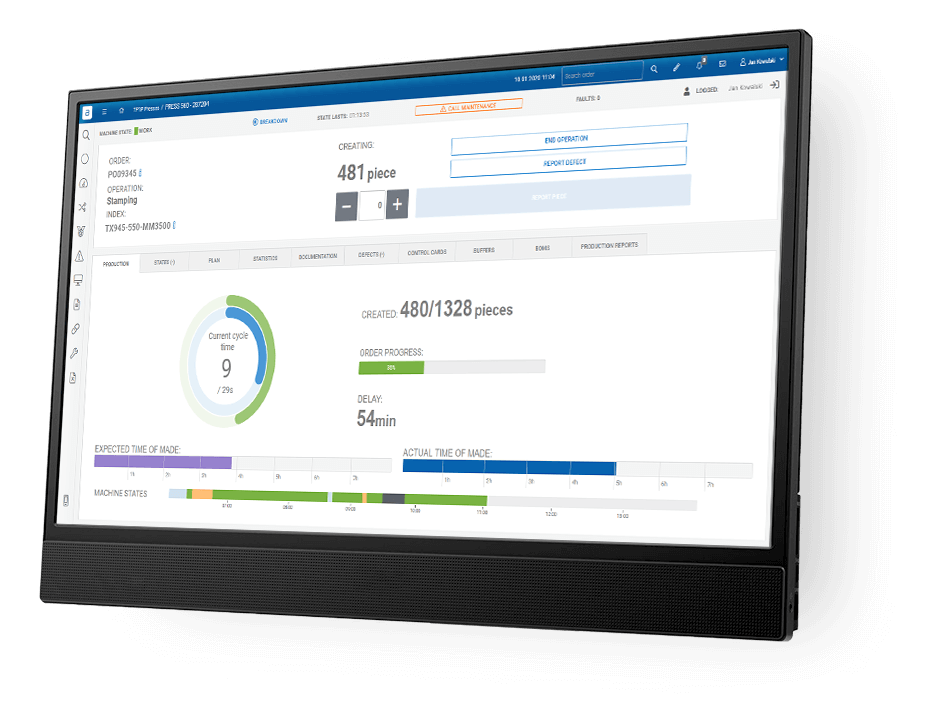
Accurate and comprehensive production reports are the foundation for every aspect of the process: from planning to activity accounting. Automation based on ERP integration makes it possible to:
- obtener datos completos en tiempo real de un ciclo de producción determinado
- generar información sobre el progreso de la producción
- evaluar los estados de las máquinas
- el número de artículos conformes en relación con los detectados,
- las razones de los posibles errores detectados en el ciclo de producción,
- ID del operador responsable del lote,
- horas de inicio y fin de la operación,
- motivo para detener la máquina,
- actualización de la finalización prevista,
- funcionamiento y tiempo de pedido,
- estado actual de la máquina,
- otros datos sobre el progreso de la producción.
Informes sobre la calidad de la producción
Thanks to automation, reporting on production quality is done in real time. In this way, information about defects occurring in production is analysed. It is important that the controller has full control over the ongoing assessment – here and now. For instance, the manager can ask the operator to perform quality checks with detailed instructions for a specific production time, if necessary. This allows, for example, to carry out inspections every 2 hours or in certain batches – e.g. when several hundred components are produced.
The overall inspection capabilities are enhanced by additional equipment. The system allows the connection of the necessary report automation tools- checkweighers, callipers or scanning machines.
Digitalización de informes SPC y gráficos de control
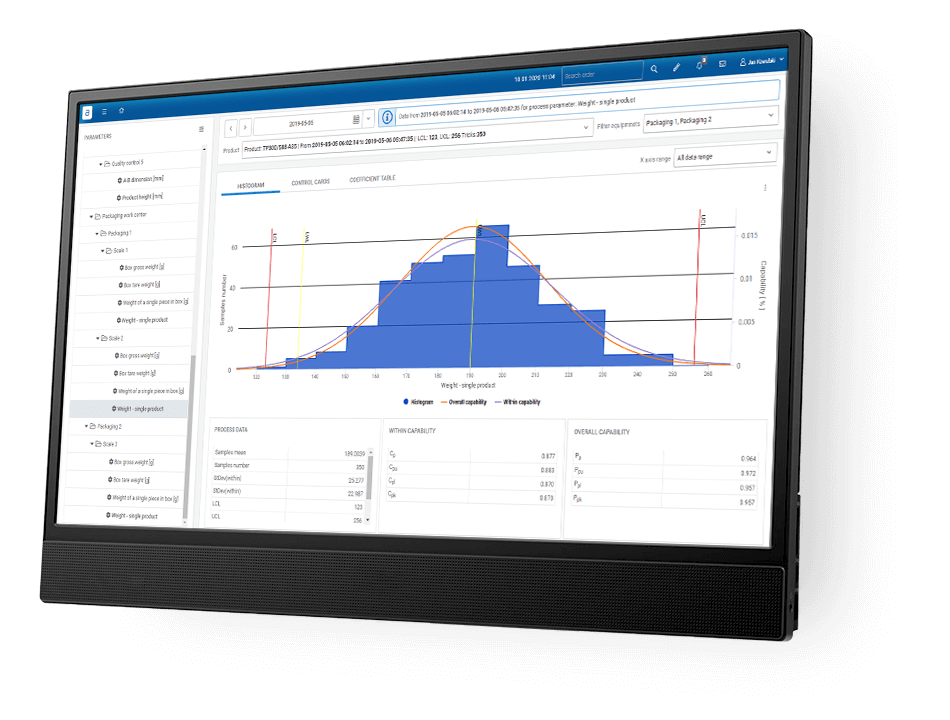
Real-time condition monitoring is not just about current efficiency, but it also leads to significant improvement when it comes to drawing conclusions for the future. For example, automation makes it possible to verify whether certain measurements are within tolerance limits. Such informa can be generated automatically after production is completed. This reduces the involvement of human labour.
Notificación de problemas de servicio
A common drawback of production lines is to slow response a technical problems. This is due to the late transmission of information. Automation eliminates this problem. Information about failures or maintenance needs is triggered automatically, along with the detailed reason. The generated notifications have different formats: e-mail, SMS, phone call. This reduces the risk of not receiving a message.
Maintenance activity reporting includes automatic measurement of maintenance KPIs – MRT, MTBF, MTTR, MTTF. The storage of data on the failure history itself – including not only causes but also repair or reaction times – runs in the background too.
Acceso desde dispositivos móviles
How to improve employee awareness and control over the production process? The solution is to provide employees with mobile devices – not just smartphones but, for instance, tablets – that have access to relevant applications. This way, they can report potential problems and their causes more quickly. Access to notifications is in real time. In addition, selected employees can access the current status of production – for example, in the form of OEE reports for a specific machine.
¿Cómo automatizar los informes con la solución Accevo MES?
El sistema automatizado de informes Accevo ya se utiliza en 35 países. Los clientes que han decidido utilizar el sistema destacan, entre otras cosas, la variedad de aplicaciones posibles. Basándose en el sistema, es posible crear los siguientes informes:
- informes de producción
- informes de calidad
- informes de mantenimiento y otros.
La recopilación de datos no sólo se aplica a los dispositivos más nuevos, sino que también es posible para los modelos más antiguos gracias a los conocimientos y la experiencia de los ingenieros de Accevo.
Data analysis is facilitated by the extremely functional y practical dashboards developed by Accevo. These are ready-made solutions based on the best experiences from various industries – FMCG, pharmaceutical, automotive, machine or aerospace. The company can therefore be sure to receive a ready-made solution adapted to the specifics of its business.
Reports collected in this way can be customised to meet company standards and reports can be generated on an ongoing basis. How does this work in practice? There is nothing wrong with, for example, sending out a series of reports in the early hours of each day with a summary of the last shift to start daily meetings with up-to-date last-day results.
Este tipo de análisis de datos puede incluir, por ejemplo:
- datos globales con la OEE total y el nivel desglosado de los resultados individuales de cada departamento o línea de producción
- una línea de producción con las condiciones reales de la máquina durante un turno y la OEE
- el rendimiento de la línea de producción con comparaciones con un periodo seleccionado del pasado
- Diagramas de Pareto de microparadas con las causas raíz de cada máquina o línea de producción.
Cómo automatizar informes en la práctica - un estudio de caso
How does an automated reporting system work in a company? Here is an example based on an implementation for a company with 45 production lines. It operates in the automotive industry.
La aplicación fue posible gracias a:
- obtención de datos de PLC y paneles de control que funcionan con 26 dispositivos modernos
- instalación de sensores para contar las piezas acabadas; se instalaron en nueve máquinas antiguas
- instalación de paneles de control en diez líneas de montaje manual para obtener información sobre el progreso de la producción
- instalar diez pantallas de 42 pulgadas para ofrecer mayor transparencia y permitir la visualización de cuadros de mando en la planta de producción.
¿Cómo se ha traducido la digitalización de los informes de producción en parámetros medibles? Tras la integración en el Sistema ERP SAP, El tiempo de funcionamiento en particular ha aumentó en 23%. Al mismo tiempo, el tiempo en control de calidad ha sido reducido por 45%. Sin embargo, la reducción global de producción tiempo de notificación, que cayó por 90%, es particularmente impresionante.

OEE Micro detiene el software de inteligencia para fabricantes
Inteligencia de OEE y Microparadas Accevo OEE Microstops & Intelligence captura los datos de la máquina en tiempo real, detecta las microparadas automáticamente y muestra dónde está realmente el rendimiento.
Software de gestión de operaciones de fabricación (sistema MOM)
Manufacturing Operations Management Software The complete manufacturing operations management software – unify production, quality, maintenance, OEE and traceability in one ISA-95 compliant platform. Trusted by

Sistema MES - Sistema de Ejecución de la Fabricación
Manufacturing Execution System Accevo MES connects machines, operators, materials and business systems to manage execution, traceability and production control in real time. Run production with
