

Aerospace & Aviation Manufacturing Software
Full traceability. Paperless build. Right first time. Accevo replaces the paper build pack with controlled digital work instructions, captures every operation and measurement as the aircraft part is built, and hands you the AS9100 evidence at the end of the job instead of at the end of a search.
Aerospace manufacturing software for airframe and component makers, aircraft interiors, engine parts, avionics and MRO shops - high mix, low volume, long product life, zero tolerance for an undocumented step.

What is aerospace manufacturing software?
Aerospace manufacturing software – sometimes called aircraft manufacturing software – is the system that runs and records the build. It holds the approved process for each part or assembly, delivers the correct revision of each work instruction to the operator, collects measurements and sign-offs as the work happens, and keeps a permanent, searchable record linking every finished item to the materials, tools, parameters and people behind it.
Aviation production is not automotive production at lower volume. The runs are short, the mix is wide, the product stays in service for decades, and the documentation obligation outlives everyone who built it. A system designed around takt time and high-volume repetition tends to fit badly. What aerospace actually needs is configuration control, build genealogy e right-first-time discipline – because rework on a certified part is far more expensive than rework on a bracket.
That is also why paperless manufacturing software matters more here than almost anywhere else. The build pack is the deliverable. When it lives on paper, every revision is a risk, every archive search is a day, and every audit is an exercise in hoping the folder is complete.
AS9100, configuration control and audit evidence
Aerospace customers and regulators do not accept a quality narrative – they audit the system that produced it. Accevo is built so the evidence already exists, contemporaneously, at the moment the auditor asks.
AS9100 & quality system
AS9100 – the aerospace quality management standard built on ISO 9001. Records are created during the build rather than assembled afterwards, so traceability and process control requirements are met by construction.
First Article Inspection – FAI measurements, evidence and approvals captured against the specific article, with the data available for AS9102 reporting rather than retyped into it.
Nonconformance & corrective action – deviations raised at the station, routed for disposition, and linked to the exact materials and parameters present at the time.
Configuration & traceability
Revision control – the operator sees only the approved revision effective for that serial and configuration. Superseded instructions vanish from the shop floor the moment they are superseded.
Build genealogy – every component lot, sub-assembly, tool and operator recorded against the serialised item, so a suspect batch can be bounded in minutes rather than weeks.
Material identity & counterfeit control – material verified at the point of use and written into the record of the assembly it entered.
Certificazioni aziendali
ISO 9001 – certified quality management across our development, delivery and support processes.
ISO/IEC 27001 – certified information security management, which matters when the build data is export-controlled or customer-confidential.
ISO 22301 – certified business continuity management, plus certificate copies and audit evidence for your supplier qualification on request.
Paper build packs vs a paperless build
The aerospace build pack is a genuinely impressive artefact and a genuinely terrible database. It is complete, it is signed, and it is completely unsearchable. Finding out how many units used a suspect fastener lot means opening boxes; confirming that everyone is on the current revision means walking the floor.
Going paperless does not change what you record – it changes when you can use it. The same signatures, the same measurements, the same sequence, except queryable in seconds and impossible to complete out of order.
Building on paper:
- Revision control enforced by hoping the right binder reached the right bench
- Missing entries and illegible values found at buy-off, days after the operation
- Traceability queries answered by opening archive boxes, one job at a time
- Operations skipped or done out of sequence, discovered only if someone notices
Building paperless:
- Only the effective revision reachable at the station, updated everywhere at once
- Values validated against limits as they are entered - out of tolerance stops the step
- Full build genealogy queryable in seconds, from serial to material lot and back
- Enforced sequence with electronic sign-off, so a skipped operation is not possible
-30%
Riduzione dei tempi di guasto
-25%
riduzione dei tempi di cambio formato
-40%
riduzione dei tempi di reazione per la manutenzione
-10%
riduzione dei consumi energetici
Key functions of aviation and aerospace manufacturing software
Nine functions matter on an aerospace shop floor, and they only work together if they share one data model. All of these run on the one Accevo Smart Factory platform, so the work instruction, the measurement and the machine signal are three views of the same build event – not three systems to reconcile. Scale up to a full Sistema di esecuzione della produzione when the shop is ready.
The complete build pack delivered and completed digitally: forms, checklists, sign-offs and buy-offs at the bench, archived automatically and searchable for the life of the part. Explore the module ➤
Instructions, drawings, photos and video served in the context of the current job and configuration. One approved revision, delivered everywhere at once, with the change history retained. Explore the module ➤
Jobs released from ERP, routed through work centres and dispatched to benches with the correct routing, BOM and effective revision for that serial. Explore the module ➤
In-process inspections with immediate in-tolerance or out-of-tolerance verdicts, read from gauges or entered by the operator, with SPC where the process warrants it. Explore the module ➤
Structured defect capture at the station, disposition workflow, and linkage to the parameters, materials and tooling present when the defect occurred. Explore the module ➤
CNC, press, oven and test-rig data read directly from the controllers, giving real utilisation and cycle data instead of estimated shop-floor hours. Explore the module ➤
Traceability and build genealogy across a 30-year product life
In aerospace the record has to outlive the programme. A part shipped today may be investigated in 2050, by people with no memory of the shop that built it. That is a database problem, not a filing problem – which is exactly what a paper build pack is bad at and an execution system is good at.
Serial-level genealogy
Every component lot, sub-assembly, consumable, tool, machine and operator is recorded against the serialised item as it is built. From a finished assembly you reach everything inside it; from a suspect material lot you reach every assembly it entered and where each one shipped.
Measurements attached to the article
Torque values, dimensional results, cure profiles, leak and functional test outcomes are captured against that specific serial rather than against the shift – contemporaneous and attributable without anyone having to be diligent about it.
Retrieval that takes seconds, not days
The complete history of any serial is a query. This is what turns an airworthiness question, a supplier escape or a customer investigation from a two-week archive exercise into an afternoon.
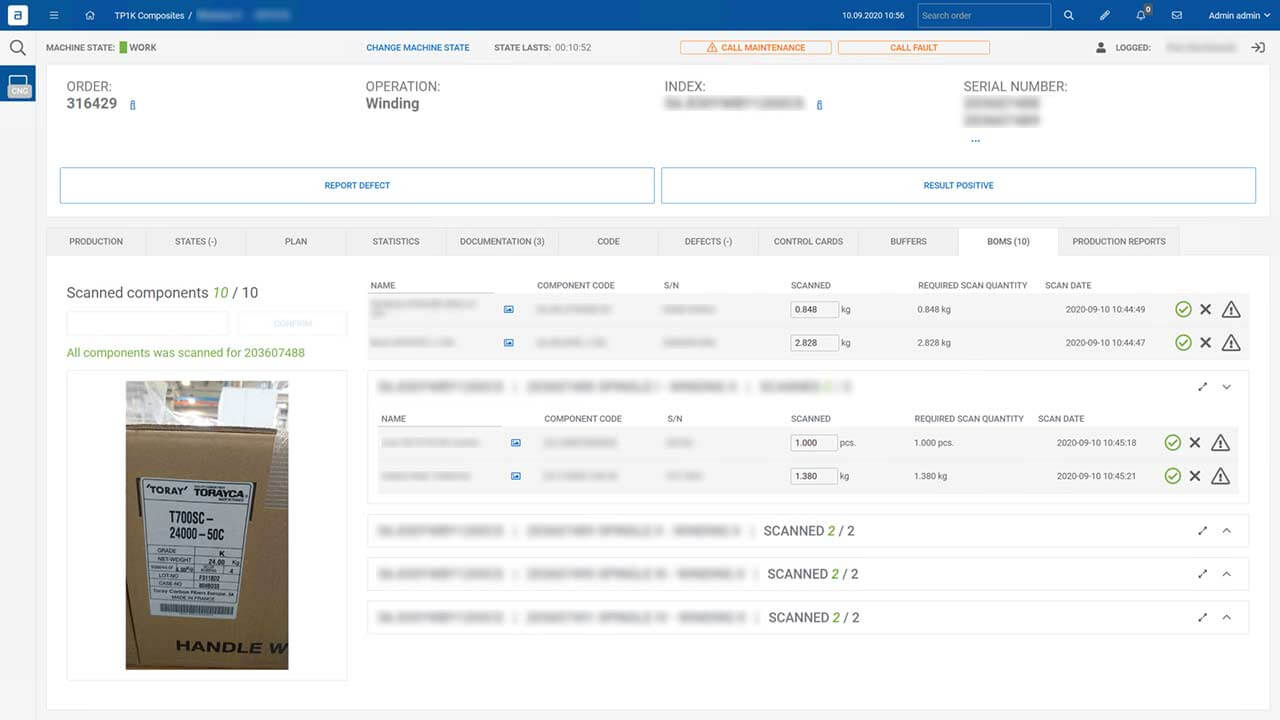
Digital work instructions and revision control
Work instruction software is where most aerospace shops get their first and largest return, because the failure mode it removes is the expensive one: someone building to a superseded revision. Every operator sees the instruction that is effective for the serial in front of them, and nothing else is reachable.
One effective revision, everywhere
Approve a change and it reaches every bench on every shift immediately. The previous revision becomes unavailable at the same moment, while remaining in the history for anything already built to it.
Rich media at the bench
Photographs, annotated drawings, 3D views and short video clips shown at the step they belong to – which is what actually reduces build variation between an experienced operator and a new one.
Enforced sequence and sign-off
Steps must be completed in order, with electronic signatures at defined checkpoints and buy-off gates that cannot be passed until the preceding inspection has been recorded.
From build pack to electronic record
Everything that was in the folder still gets recorded – it simply becomes data. That is what makes the archive useful during an investigation instead of merely compliant during an audit.
Electronic forms and checklists
Setup checks, torque records, cleanliness and FOD checks, cure logs and inspection sheets completed on screen, with every value validated against its limits as it is entered.
First Article Inspection evidence
FAI measurements, characteristics and approvals captured against the article and retained with it, ready for AS9102 reporting rather than transcribed into it afterwards.
Stock, kit and parts management
Kit issue and shortage visibility at the work centre, with material identity verified at the point of use and consumption written straight into the build record.
Dashboard e report
Ready-made reports on job progress, work-centre load, defects and rework, with aggregated and detailed views available in seconds and exportable to Excel.
Where aerospace manufacturing software is going
Four shifts are already visible in aerospace shops rather than merely predicted. None of them work without the data layer underneath – which is the practical argument for connecting machines and going paperless first, before buying anything with the word intelligent on the box.
AI and predictive maintenance
Pattern detection across machine signals to anticipate failures and surface the causes behind recurring stops rather than merely logging them.
Augmented reality at the bench
Overlaid assembly guidance for complex, low-repetition builds where a photograph is not enough and a second operator is expensive.
Cloud and multi-site deployment
Edge collection with central processing, so a second site or a new programme is a configuration rather than a fresh implementation.
Built for every role in an aerospace shop
Quality Manager
Walk into an AS9100 audit with the evidence already assembled. Revision control is enforced rather than trusted, FAI data sits with the article, and a traceability question is answered from the desk rather than from the archive.
Responsabile di produzione
See job progress by work centre and serial while the shift is running, with shortages, held items and rework visible before they become a schedule problem.
Operations Director
Real utilisation and rework cost per programme instead of booked hours – the numbers that tell you whether a bid was priced correctly and where the next capacity actually needs to go.
Aerospace manufacturing on Accevo

RECARO Aircraft Seating
Paper eliminated from aircraft seat assembly
Digital work instructions and electronic records replaced the paper documentation flow across seat assembly, giving quick data access, efficient report storage and far better transparency between shifts and departments.
How to choose the right software for your aviation company
Four things decide it, and only one of them is the licence. Understand your needs – name the three losses you are removing and how you will measure them. Check features against your process, not against a demo. Cost the whole life, including machine connectivity, ERP integration and internal effort. Check the vendor: references in aerospace, security posture, and whether they connect machines themselves or subcontract it.
We do the automation work with our own engineers, including wiring, gateways and edge devices. Bring us one work centre, your current build pack and your ERP, and we will show you what the paperless version looks like before you commit to anything.

Domande frequenti
Aerospace and aviation manufacturing software, explained
Aerospace manufacturing software runs and records production of aircraft parts and assemblies. It holds the approved process, delivers the effective revision of each work instruction to the operator, captures measurements and sign-offs as the work happens, and maintains a permanent link between every serialised item and the materials, tools, parameters and people behind it.
Aerospace is high mix and low volume with a product life measured in decades, so the emphasis falls on configuration control, revision management and build genealogy rather than on takt time and cycle optimisation. Systems tuned for high-volume repetition usually fit aerospace badly. See our automotive manufacturing software page for that side.
Yes. Accevo supports the traceability, process control, first article inspection and nonconformance requirements of AS9100 by producing records during the build rather than assembling them afterwards. Company certifications - ISO 9001, ISO/IEC 27001 and ISO 22301 - are available for supplier qualification.
It means the build pack itself becomes digital: work instructions, forms, checklists, measurements and signatures completed at the bench and archived automatically. The same information is recorded, but it becomes searchable, revision-controlled and impossible to complete out of sequence.
Each instruction has an approved revision with an effectivity. The operator can only reach the revision effective for the serial in front of them; when a change is approved it reaches every bench immediately and the previous revision becomes unavailable, while remaining in the history for items already built to it.
Yes. Accevo integrates bidirectionally with SAP (including RFC), Oracle, Infor and others through web services, intermediate databases or file interfaces. Jobs, BOMs and routings come in; progress, consumption and quality data go back. Aerospace ERP software and an execution layer solve different problems and normally coexist.
CNC machining centres, presses, ovens and autoclaves, test rigs and measurement equipment - via OPC UA and DA, Siemens S7, Allen-Bradley, Beckhoff, Heidenhain, MTConnect, Modbus TCP and others. Where a machine exposes nothing useful, our engineers add sensors, counters or I/O modules.
Yes - that is the normal aerospace case and the platform is configured for it. Short runs, wide product mix and frequent engineering change are handled through configuration and effectivity rather than through custom development per part number.
Articoli recenti

Tracciabilità nella produzione
Production tracking software that follows every material, batch and container through production – so you can trace any product forward or back.

Quali funzioni MES giustificano il costo? Una lista di controllo per l'acquirente
Ogni fornitore di sistemi MES vi presenterà un elenco di funzionalità lungo tre pagine. Il problema non è la mancanza di funzionalità. Il problema è capire quali di esse facciano davvero la differenza per il vostro impianto e quali invece gonfino il prezzo senza offrire un valore proporzionato. Perché la scelta delle funzionalità è determinante per il sistema MES
L'IA agentica nel settore manifatturiero: casi d'uso, livelli di autonomia e da dove iniziare
Agentic AI in manufacturing is software that plans and executes multi-step work across your factory systems. It detects a problem, decides what to do, and takes action, with a human setting the boundaries. Adoption is early but accelerating: in a 2025 Manufacturing Leadership Council survey, 6% of manufacturers said they