

In pharmaceutical manufacturing, MES manages broader production execution, while an electronic batch record (EBR) captures the evidence of how a specific batch was made. An EBR can sit inside an MES, connect to it as a separate application, or form part of a wider integrated platform. The right boundary depends on the site’s intended use, process and validated system design.

MES vs EBR in pharma: the short answer
A sistema di esecuzione della produzione (MES) coordinates defined production activities on the shop floor. Depending on the scope, it can manage work dispatch, recipe or work-instruction execution, material and equipment checks, process data, exceptions and traceability.
Un registro elettronico dei lotti records the executed batch. It brings together the required instructions, operator entries, process results, events and review information for that batch. Electronic signatures and audit-trail functions apply where the process and system requirements call for them.
These terms describe different scopes. They do not guarantee a particular vendor architecture. Some platforms offer EBR as an MES function. Other plants connect an EBR application to MES, equipment, ERP or laboratory systems.
What each system typically covers
| Question | MES scope | EBR scope |
|---|---|---|
| Primary job | Coordinate and record defined production execution activities | Compile the executed record for a batch |
| Main unit | Production orders, operations, equipment, people and materials | One batch or lot and its required execution evidence |
| Typical information | Dispatch status, instructions, material checks, equipment context, process events | Completed steps, recorded values, operator actions, exceptions, review status |
| Typical users | Operators, supervisors, planners, engineers and system owners | Operators, reviewers, quality teams and authorized approvers |
| Output | Execution status and production context for the defined scope | A traceable record that supports review and disposition |
Use this table as a starting point for requirements. A site should document which system owns each field, event and decision. Product names alone cannot answer that question.
How the two fit during a batch
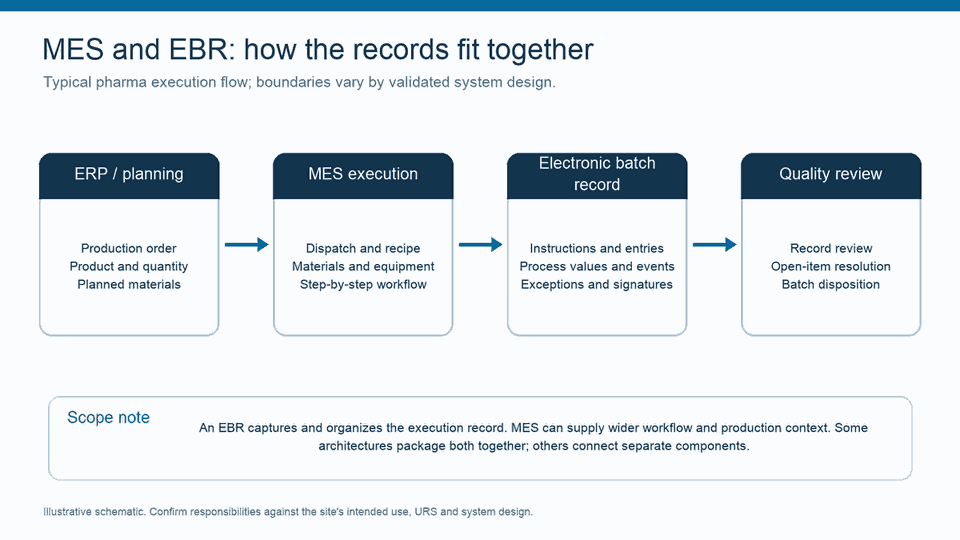
Consider a tablet batch. ERP may send the production order and planned quantity. MES can dispatch the order, present the configured instructions and check material or equipment status. During execution, the EBR records the steps, entries and events that the site’s process requires. Reviewers then resolve open items under the site’s quality process.
The EBR is the record of execution. MES supplies operational context and coordinates the steps within its configured scope. The boundary may be a module boundary, an interface between applications, or a combined workflow. Map the actual data flow before you select or validate a solution.
Where responsibilities overlap
Both systems may handle recipe instructions, operator confirmations, electronic records, exceptions and review tasks. The implementation specification should say which component creates each record, which system stores the authoritative version, and how another system receives a copy or status update.
For each handoff, define the triggering event, required fields, timestamp source, acknowledgement, error handling and recovery path. Include the link between the batch record and related material, equipment, laboratory or quality records. These details matter more than whether a vendor calls a screen an MES function or an EBR feature.
What regulations say about electronic records
Regulatory obligations depend on the records a manufacturer must maintain and how the computerized system supports GMP work. FDA’s Part 11 guidance explains how the agency applies requirements for electronic records and signatures. EU GMP Annex 11 addresses computerized systems used in GMP activities. Neither document defines a universal commercial boundary between an MES and an EBR; the manufacturer must determine applicable requirements for its use case with its quality and regulatory teams.
For implementation and validation planning, see Accevo’s guide to pharmaceutical MES and EBR system validation e il MES for pharma overview. Review the applicable source documents: FDA Part 11 guidance e EudraLex, volume 4.
How to decide what your plant needs
- Start with the process. List the production steps, decisions, records and review tasks that the system must support.
- Set the boundary. Identify what ERP, MES, EBR, LIMS, equipment controls and quality systems already own.
- Map the record. Trace each required entry back to its source, user, timestamp and related batch or material.
- Define exceptions. Specify how the workflow handles missing values, out-of-range results, equipment alarms, corrections and rework.
- Write testable requirements. Connect the user requirements to configuration, interface tests, access controls, audit-trail review and end-to-end process tests.
- Choose the architecture. Compare standalone EBR, integrated MES and phased approaches against the documented requirements, not a feature list alone.
Questions teams ask
Can a pharmaceutical company use an EBR without a full MES?
Yes, some projects focus on digitizing batch records and associated review workflows. The team still needs to define how the EBR receives production context and how the process handles equipment, material and quality data outside its scope.
Does every MES include an EBR?
No. Capabilities differ by product and configuration. Confirm that the proposed system supports the records, controls, signatures, review steps and interfaces in the site’s requirements.
Which should a pharma plant implement first?
Start with the manufacturing problem and required records. A scoped EBR project may fit a batch-documentation need; a broader MES may fit execution, materials, equipment and cross-process needs. Accevo’s Piano di implementazione del sistema MES nel settore farmaceutico covers how to define and phase a rollout.
A clear MES and EBR boundary gives operations, quality and IT one shared view of who records what, where the record lives and how the plant verifies it. Document that design before configuration begins.
