

A production data collection system (PDCS) collects information about what happens on the shop floor and turns it into usable production records. It can combine automatic signals from machines with entries made by operators, then attach timestamps and context such as the asset, product, order or shift. Manufacturers use those records to see production progress, investigate losses and supply other systems with trustworthy operational data.
PDCS is a descriptive label rather than one fixed industry standard or feature list. Similar functions may be called machine data acquisition, shop-floor data collection or production monitoring. The practical question is which events and measurements the system captures, how it checks them and where the resulting records go.
What data does a PDCS collect?
The data depends on the process and the decisions the plant needs to make. Common examples include:
- Machine events: running, idle, fault and changeover states; alarms; start and stop times.
- Production quantities: good, rejected and reworked counts, cycle counts and completed units.
- Process values: selected temperatures, pressures, speeds or energy readings with units and timestamps.
- Operator records: downtime reason codes, checks, corrections and comments that a machine cannot infer.
- Context: the equipment, line, product, batch, production order, material or shift associated with each event.
A signal alone rarely answers a production question. For example, a PLC may report that a conveyor stopped at 10:14. The useful production record also identifies which line and order were active, when the stop ended and whether the reason was a jam, changeover or missing material.

How does production data collection work?
First, the system connects to approved data sources. Depending on the equipment, this can include PLCs, sensors, machine interfaces, industrial protocols such as OPC UA, or an operator panel. It captures events and values, records their time and source, and may buffer them during a network interruption. It then applies defined rules for units, event boundaries, missing values and duplicate records.
The next step is contextualisation: linking a machine event or measurement to the correct asset, order, product and time window. The cleaned, contextualised data can be stored for analysis or passed to MES, OEE monitoring, reporting and other authorised systems. Each connection needs an agreed definition of the data it sends and receives.
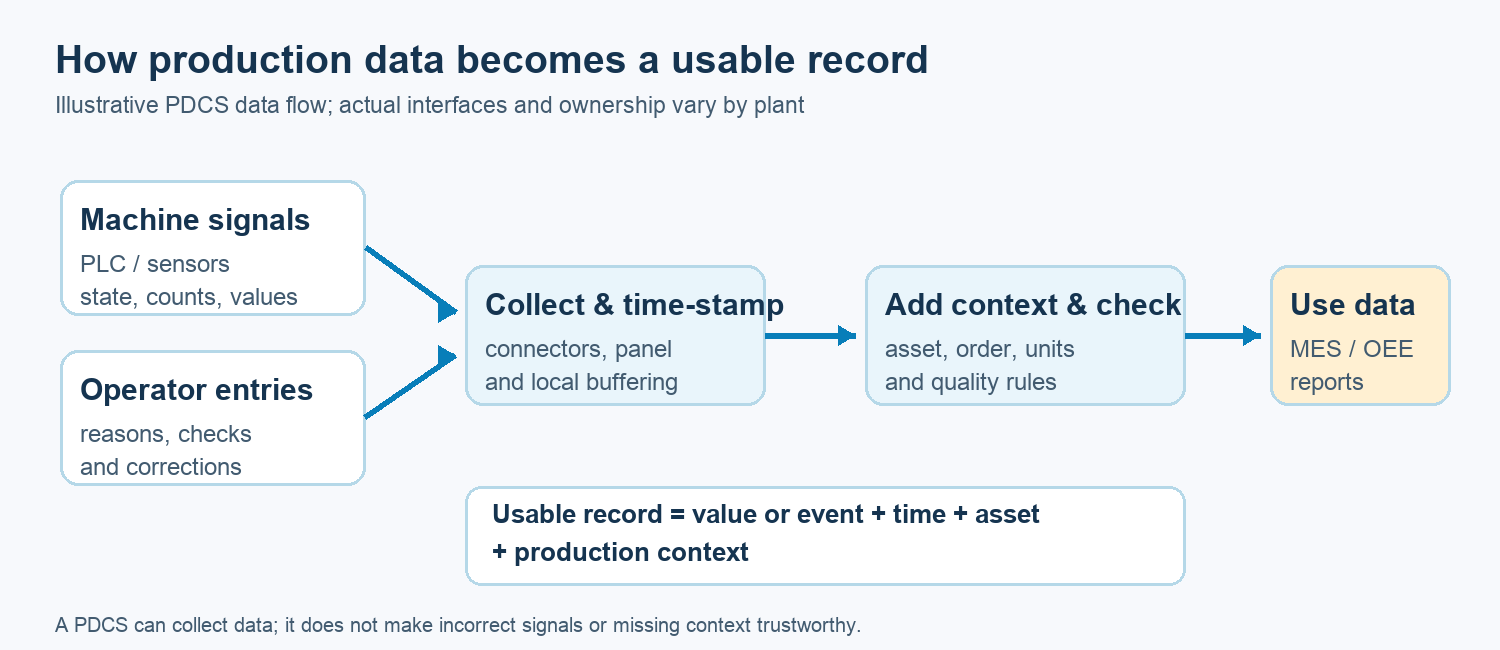
Automatic data and operator input
Automatic capture is useful for frequent events such as machine states, counts and process values. It reduces the need for manual transcription, but it does not explain every event. An operator may need to select a reason code, confirm a material change or record a quality observation. Good data collection therefore combines automation with simple, well-defined human input where it adds meaning.
The design should make corrections visible rather than silently overwriting an earlier record. Teams also need rules for clock synchronisation, offline operation, access rights and who approves changes to reason codes or other master data.

PDCS compared with PLC, SCADA, historian and MES
A PLC controls equipment according to its logic. SCADA supervises industrial processes and presents alarms, trends and controls. A data historian retains time-series process values. A PDCS focuses on collecting production events and measurements and giving them enough context for operational use. A manufacturing execution system (MES) has a wider role in coordinating and recording production work. These functions can overlap in one product, so names alone do not define the system boundary.
What can a manufacturer do with the data?
Reliable collected data can support shift reports, downtime analysis, traceability checks and measures such as OEE. Those outputs still require agreed rules. A count is only useful when the team knows whether it includes rejects; a downtime report needs consistent definitions for planned stops, microstops and changeovers. More data does not automatically mean better decisions.
What should be planned before implementation?
- Start with the operational questions or reports the plant needs, then specify the minimum data required.
- Map each source signal or manual entry to an asset, event definition, unit and owner.
- Check data quality on real shifts, including start and stop times, count resets, missing data and network outages.
- Agree where records are stored, how corrections are audited and which system owns each production identifier.
- Test the hand-off to MES or reporting with operators, engineers and quality teams before expanding to more lines.
For more on the connection layer, see Accevo machine connectivity. The ISA-95 overview provides a broader model of how control and manufacturing operations systems exchange information.