

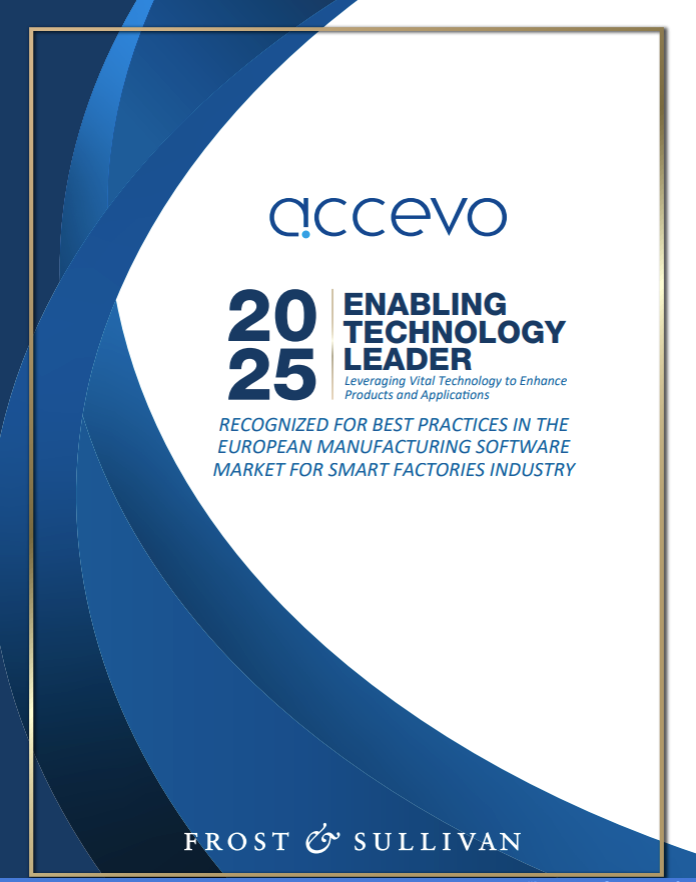
Accevo recognized as a 2025 Enabling Technology Leader
Frost & Sullivan recognizes Accevo for best practices in the European manufacturing software market for smart factories.
Frost & Sullivan is a global research and advisory firm with over 60 years of experience evaluating technology, innovation, and growth strategies across industries worldwide.
What the recognition is?
Frost & Sullivan's Enabling Technology Leadership recognition is awarded to a company judged to have developed a technology that materially advances what its customers can do, and to have delivered it in a way that produces measurable results in the field.
The assessment is not a popularity exercise or a paid listing. It weighs two dimensions – technology leverage and customer impact – and reviews evidence of innovation, scalability, implementation efficiency and value delivered over time.
For a buyer, the useful part is not the trophy. It is that an independent analyst firm examined the same questions you would ask during an evaluation, and published what it found.
What Frost & Sullivan assessed
Three dimensions, applied to the European manufacturing software market for smart factories. Each maps onto a question that comes up in every serious software evaluation.
Technology leverage
Innovation – whether the technology does something materially better rather than merely differently.
Scalability – whether it extends from one line to a plant to a group without a migration in between.
Breadth of capability – whether a single platform genuinely covers the operational scope it claims.
Customer impact
Implementation efficiency – how quickly and predictably deployments reach a working state on real production lines.
Measurable outcomes – improved OEE, reduced microstops, faster reporting and shorter recovery times, evidenced rather than asserted.
Long-term value – whether the benefit persists after go-live and continues as scope grows.
Market scope
European manufacturing software – the smart factory segment specifically, rather than industrial software in general.
Across industries – FMCG, pharmaceuticals, automotive, tobacco and process manufacturing.
Independent analysis – conducted by Frost & Sullivan using its own best practices methodology.
2025
Enabling Technology Leadership
8
platform modules assessed
5
key strengths cited
Europe
manufacturing software market
Key features of Accevo APS software
Everything a planner needs in one web-based advanced planning scheduling system – no client install, accessible from anywhere, with the planner always in control of the automated result.
Automated planning & optimisation engine
Generate a feasible, optimized schedule at the push of a button. The engine balances up to seven weighted target criteria – setup costs, production costs, personnel costs, throughput times, capacity utilisation, capital commitment and delivery reliability.
Multi-resource planning
Machines and work centres, personnel with qualifications, production resources and tools, and material – all planned simultaneously, so a plan is never blocked by the one resource nobody checked.
Integrated MRP with ATP/CTP
Material requirements planning with lot-size optimisation, hybrid pull-push strategies and live Available-to-Promise checks. Demand planning over medium and long horizons uses both actual and forecast requirements to keep the supply chain synchronised.
Bottleneck-oriented scheduling
Multi-level BOMs are scheduled around the constraint, minimising total throughput time across the order network while keeping work-in-progress down. Bottleneck analysis becomes routine, not detective work.
Shop-floor feedback from MES
Confirmations, machine states and order progress flow back from Accevo MES in real time, so the plan reflects what is actually happening – not what was assumed this morning.
AI-supported planning & analytics
A self-learning layer analyses historical production data, flags expected deviations early and forecasts realistic process durations – making every next plan more accurate than the last.
The six strengths Frost & Sullivan cited
Taken from the published analysis. They are worth reading less as praise and more as an independent summary of where this platform differs from the alternatives you are probably also evaluating.
01
A single modular Smart Factory platform
MES, MOM, OEE, APS, CMMS, EMS, paperless and quality systems on one data model, rather than a suite assembled from acquisitions.
02
Production performance focus
Built around what production actually loses – stops, speed, scrap, changeover – rather than as a general IoT toolkit looking for a use case.
03
Scalable modular deployment
Start on one line with one module and extend by configuration, which is what makes a group rollout a rollout rather than a series of projects.
04
Machine connectivity expertise
New and legacy equipment alike, connected by Accevo’s own automation engineers including the hardware and wiring. Frequently the deciding factor in an evaluation.
05
Structured, fast implementation
A defined deployment model with the technical assessment done up front, which is why timelines hold more often than they slip.
06
Measurable outcomes in the field
Improved OEE, reduced microstops, faster reporting and shorter recovery times – across FMCG, pharma, automotive, tobacco and process industries.
Why an analyst recognition is worth anything at all
Plenty of awards are marketing instruments, and a buyer is right to be sceptical. What makes this one useful is the scope of the assessment: it looked at implementation efficiency and long-term value, not just at feature lists – the two things a demo cannot show you and a reference call only partly covers.
It also states a position we argue for on every page of this site, from a source with no commercial interest in whether you agree: that the constraint in factory digitalisation is rarely the software. It is whether the machines can be connected, and whether the deployment reaches a working state before the budget review.
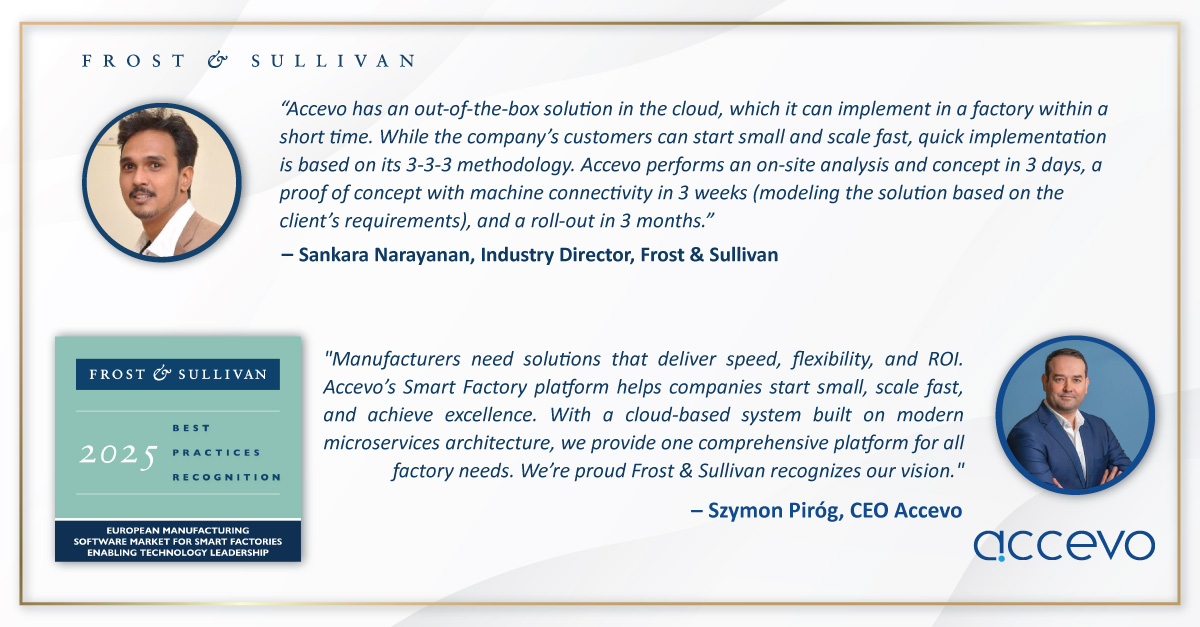
The outcomes behind the assessment
Four measurable results cited in the analysis – each of which is a page on this site, because each is a module you can buy separately and measure separately.
Improved OEE
Availability, performance and quality calculated live from machine signals, with losses ranked by cost. OEE monitoring.
Reduced microstops
Short stops detected automatically and attributed to a cause – usually the largest hidden loss on a fast line. Microstops and downtime.
Faster reporting
Automatic production reporting and ERP integration removing duplicate data entry and the end-of-month reconciliation. MES.
Shorter recovery times
Andon calls routed and escalated automatically, with response time measured rather than assumed. CMMS and maintenance.

Read the analysis, then test it against your own plant
The report sets out what Frost & Sullivan examined and concluded. It is worth reading before an evaluation, because it covers the criteria that are hardest to assess from a demo.
Then bring us the harder test: your machine list, your line losses and your system landscape. An independent recognition is a reasonable starting point, but the only assessment that matters is the one done on your own equipment.
Frequently Asked Questions
The Frost & Sullivan recognition, explained
The 2025 Enabling Technology Leadership recognition from Frost & Sullivan, for best practices in the European manufacturing software market for smart factories.
A Frost & Sullivan best-practices recognition awarded to a company judged to have developed a technology that materially advances customer capability, and to have delivered it with measurable impact. The assessment weighs technology leverage against customer impact.
Innovation, scalability and implementation efficiency on the technology side, and measurable outcomes and long-term value on the customer side - across FMCG, pharmaceutical, automotive, tobacco and process manufacturing deployments.
A single modular Smart Factory platform spanning MES, MOM, OEE, APS, CMMS, EMS, paperless and quality systems; a focus on production performance rather than isolated IoT tooling; scalable modular deployment; machine connectivity expertise covering legacy equipment; and a structured, fast implementation approach.
The full Frost & Sullivan analysis is available to download from this page. It is the most useful independent summary of the platform we can point you at.
No - and we would not claim otherwise. It means an independent analyst examined the questions you would ask and published its findings. Whether it works on your equipment depends on your machines, your losses and your systems, which is what an automation assessment establishes.