

A critical process parameter (CPP) is a process variable whose variation can affect a critical quality attribute, and which therefore needs monitoring or control. In pharmaceutical manufacturing, the classification depends on the product and process: temperature, mixing time or pressure is not automatically a CPP simply because the team measures it.
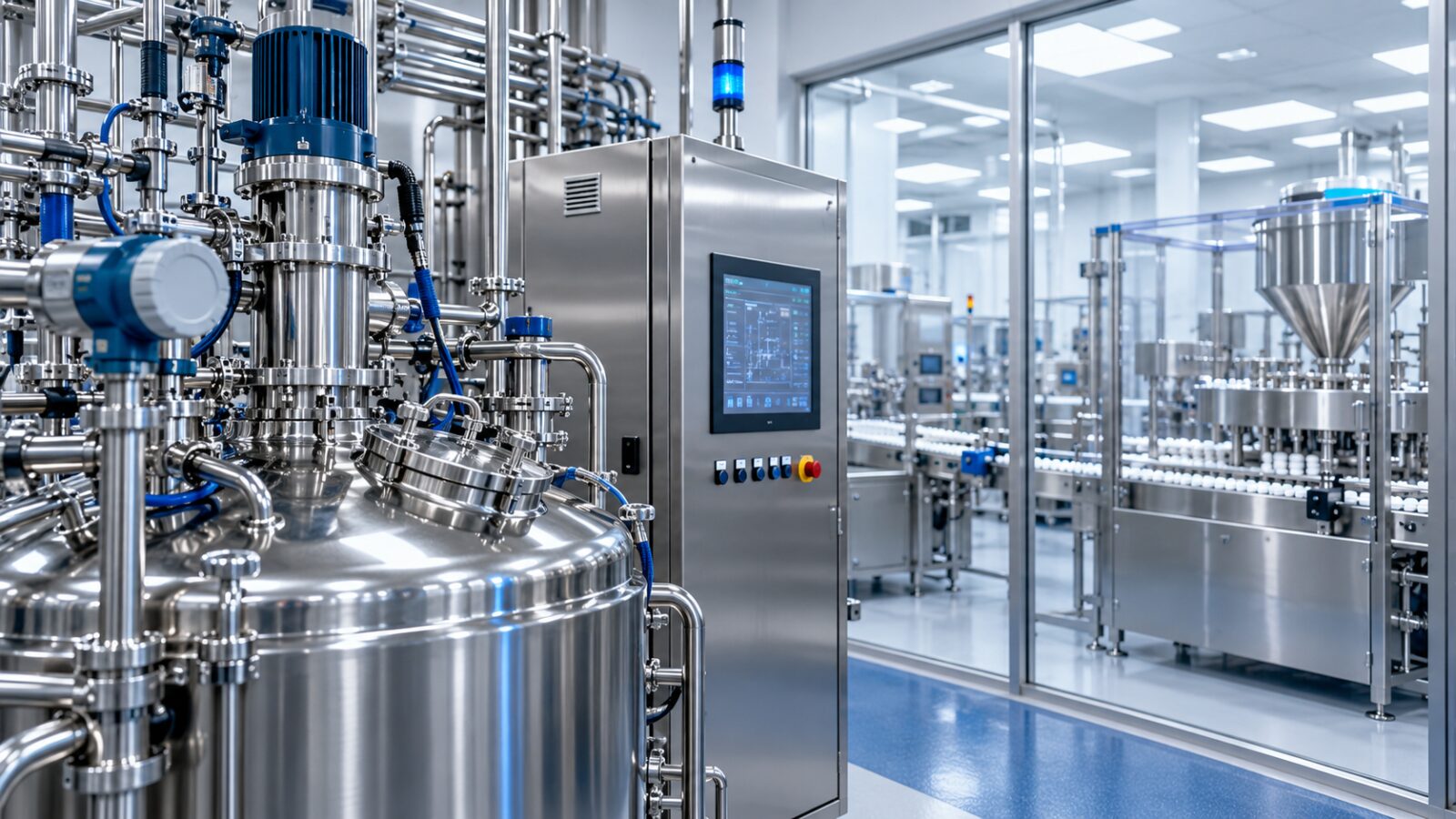
Ilustración generada por IA. No representa ninguna instalación de Accevo ni de sus clientes.
Critical process parameters and critical quality attributes
ICH Q8(R2) defines a CPP through the effect of its variability on a critical quality attribute (CQA). A CQA is a physical, chemical, biological or microbiological property that should stay within an appropriate limit, range or distribution to achieve the desired product quality.
Process development and quality teams investigate the relationship between a parameter and an attribute. They use process knowledge, experiments and risk assessment to decide whether the parameter is critical and how to control it. A variable that matters for throughput or equipment protection may still need attention, even if its relationship to a CQA does not make it a CPP.
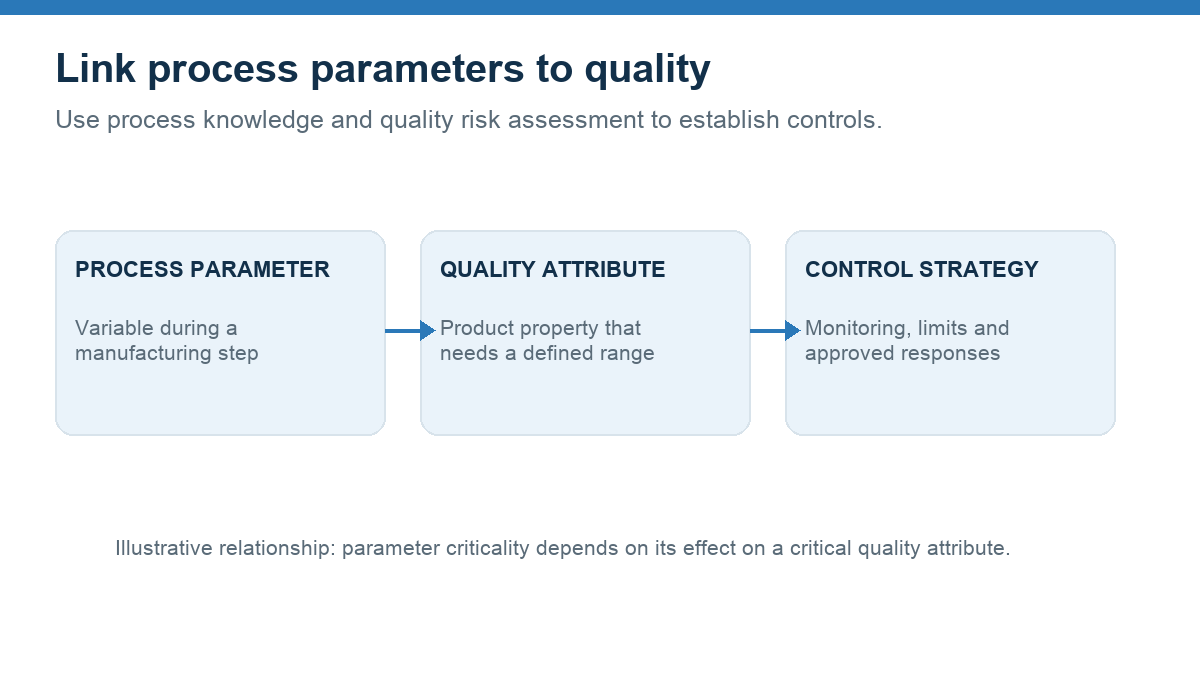
Illustrative relationship. A parameter’s classification depends on evidence for the specific product and process.
Examples of potential CPPs in pharma
The examples below are illustrative starting points for an assessment. They are not classifications or operating limits for a real product. A site must establish the relationship to its own CQAs and process:
-
Blending: mixing time or equipment speed may warrant study alongside blend and content uniformity.
-
Granulation and drying: spray rate, inlet temperature or drying time may warrant study alongside moisture and downstream product properties.
-
Tablet compression: compression force may warrant study alongside mechanical properties and dissolution.
-
Bioreactor operation: pH, temperature or dissolved oxygen may warrant study alongside relevant product quality attributes.
The same variable may have a different role in another formulation, equipment train or scale. Investigate possible interactions among variables rather than assigning criticality from a generic list.
How teams identify critical process parameters
-
Define the product quality attributes: document the attributes and quality targets relevant to the product.
-
Map unit operations: list material attributes, process parameters, equipment and measurement points for each step.
-
Assess risk: use scientific understanding and available evidence to prioritize potential effects on CQAs.
-
Study relationships: use suitable experiments, prior knowledge and process data to investigate effects and interactions.
-
Define controls: document monitoring, operating ranges, responsibilities and responses to deviations in the control strategy.
-
Review through the lifecycle: update the assessment under the site’s change process when knowledge, materials, scale or equipment change.
Design of experiments can help teams study several factors and their interactions. Historical batches can provide context, but correlations alone may not establish a causal relationship. The ICH Q8/Q9/Q10 points to consider discusses the relationship between parameter criticality, quality attributes and quality risk management.
Operating ranges, limits and design space
A team establishes a parameter’s operating range from the available development evidence, measurement capability and approved control strategy. ICH Q8 describes a proven acceptable range for a single parameter with other parameters held constant. A design space addresses combinations and interactions of variables and is subject to regulatory assessment and approval. Neither a generic example nor equipment defaults establish an approved range for a particular product.
Document the parameter, unit, measurement point, sampling frequency, applicable range and response when a reading falls outside the expected condition. Quality and process owners should assess exceptions using site procedures and the relevant product context.
Monitoring a CPP during manufacturing
Operators and engineers may use control systems, calibrated instruments, process historians and batch records to monitor process variables. Depending on the approved design, a system may collect readings, present a trend, alert an operator or capture an exception for review. The control strategy determines what to measure and how people respond; a dashboard alone does not establish control.
The graph below contains invented example readings solely to illustrate a time series. It does not show a validated range, a customer process or a recommended operating limit. A production team would compare qualified measurements with its own approved limits and investigate according to its procedures.
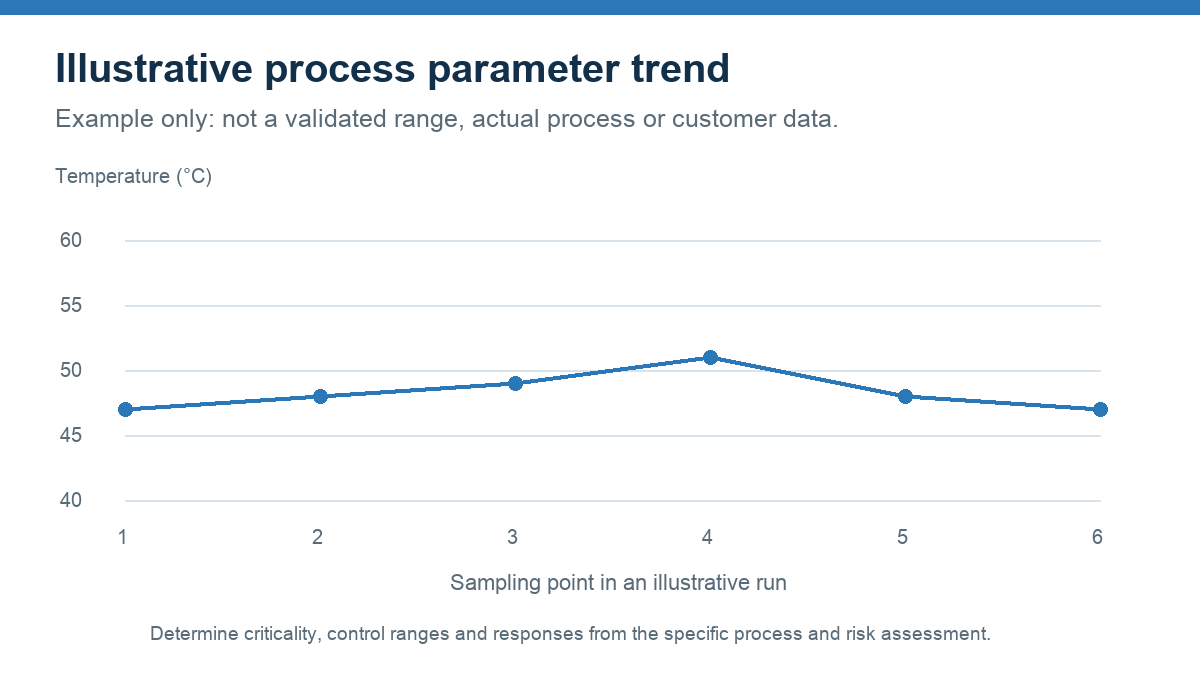
Illustrative values only. This is not measured plant data or a validated operating range.
How MES and electronic batch records support CPP workflows
An MES can guide operators through defined manufacturing steps and capture values or events from people and connected equipment, where the interface and workflow support that use. An electronic batch record can assemble the evidence needed for review, including recorded values, exceptions and operator actions. The automation system and site procedures retain their assigned responsibilities for equipment control and quality decisions.
Before connecting a parameter to a batch workflow, agree on the source instrument, unit, timestamp, batch association, expected data frequency and the action for missing, late or out-of-range values. Review how the site will handle corrections, equipment changes and system outages. Explore the difference between MES and EBR, El pharma MES integration guide and Accevo’s pharma manufacturing software overview.
Common CPP questions
Is every process parameter a CPP?
No. A CPP is identified by the effect of its variability on a CQA and the resulting need to monitor or control it. Other parameters may still be important for safety, performance or equipment operation.
Can a CPP change during the product lifecycle?
Teams may reassess criticality and controls as process knowledge or operating conditions change. Use the site’s quality risk management and change processes and evaluate applicable regulatory commitments.
Do electronic records guarantee compliance?
No. Compliance depends on intended use, the applicable requirements, system configuration, procedures and evidence. Electronic records are one part of the site’s quality system.
