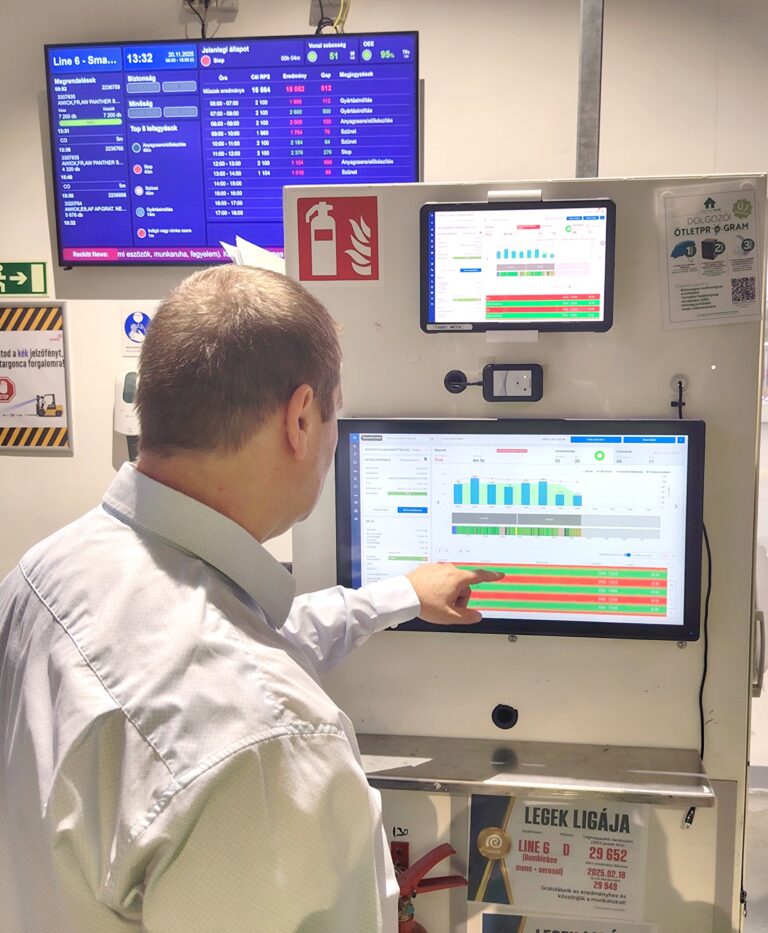
Vestacy in Tatabánya (former Reckitt in Tatabánya) has taken a major step toward digital transformation by introducing Accevo’s MES across its production environment. The change brought structure, visibility, and measurable performance gains within a short time. In this interview, Laszlo Sipos “Sipi”, Digitalization Leader, shares the story behind the project and the impact it has had on daily operations.
Project Background
Q: What made you start this initiative? What problem were you trying to solve?
A: “We did not have any solution. All data were collected manually,” Sipi said. The team relied on operators and supervisors writing down events, stops, and performance information, which made it difficult to see what was happening in real time. “We had no information about the time wasted on the shop floor or the production line. When we counted everything together, we were losing 200–300 minutes per day. Without accurate data we couldn’t analyse our processes or understand where the issues came from.”
The lack of visibility created a gap between the real performance of the lines and the assumptions used in planning and improvement. “We needed to know the actual situation on the line and what our OEE really is. Only then could we make the right decisions.”
Goals and expectations
Q: What expectations did you set at the beginning?
A: “We wanted to increase OEE, reduce waste, and avoid human mistakes during the production process.” Sipi described that these issues were not isolated events but repeating patterns, often caused by the absence of system checks. “If people took the wrong materials from the warehouse, only the operator could stop and recognized the fault. There was no BOM scanner, no validation, no control over material management on the shopfloor. Without these safeguards, every shift had the risk of errors that could stop the line or compromise production.”
The MES project was expected to bring consistency, standards, and automated verification so the team could focus on improving performance instead of firefighting.
Why Accevo?
Q: What motivated you to choose Accevo as your partner?
A: “The Accevo team is fantastic. They have a lot of experience and the communication was exceptionally good,” Sipi said. The decision wasn’t based solely on the software features. The way the Accevo team approached discussions, asked questions, and adapted the solution was equally important. “I felt we created a real bond with mutual understanding of what we wanted to achieve. It wasn’t a typical vendor–customer setup — it felt like a partnership.”
This sense of shared ownership helped move the project forward quickly and kept both teams aligned.
I can’t imagine work without this system anymore.
Laszlo Sipos "Sipi"
Implementation experience
Q: Did anything stand out during implementation?
A: “The collaboration stood out the most,” he noted. “The team understood our challenges from day one. The process was smooth and aligned with our goals.” What also impressed him was the speed of communication and the willingness to clarify even small details before they became problems. The joint workshops, testing periods, and daily conversations reinforced the feeling that both teams were building something together, not simply installing software.
Measurable results
Q: What improvements have you observed since introducing MES?
A: “We overreached our targets,” Sipi said. The shift from manual processes to automated data collection had an immediate effect. “Our general OEE target was +2%, and the result has doubled, and it is inculde the TPM metric as well. Waste dropped by a large margin.” Operators could rely on system validation, reducing errors related to materials and setups. “BOM validation became easier and operators aren’t making mistakes where the system was implemented. We now have full visibility over the shop floor.”
The availability of real-time data also changed how decisions are made. Supervisors can now address issues at the moment they appear, rather than after the fact.
Impact on daily work
Q: How has the new system influenced daily routines for operators, engineers, and managers?
A: According to Sipi, the difference is visible from the first minutes of each shift. “Operators manage everything in one system instead of multiply systems. The UX is much better, which simplifies their work.” The reduction in the number of tools eliminated confusion and repetitive data entry.
Another effect was the shift in how daily meetings are held. “All units now conduct meetings using MES data. It helps us understand what is happening on the shop floor in real time.” Engineering teams have clearer visibility into the causes of stops, while managers can track trends and plan improvements based on facts.
He added: “Before, we had to collect data manually and we were focused on gathering information. Now we can focus on root causes and meaningful improvements. We can generate reports easily and discuss real changes. It transformed our mindset.”
What’s next
Q: What are the next steps in your digitalisation roadmap?
A: “We would like to implement EMS, a skills management matrix, and CMMS to further increase our performance.” These systems are expected to expand the ecosystem around MES, allowing the site to manage energy efficiency, workforce skills, and maintenance processes in a unified digital environment.
MES is our future and our chance to achieve our targeted goals and expectations.
Laszlo Sipos "Sipi"